
Wigan Council reports the launch of a borough-wide food partnership involving community, business and public-sector organisations. Affordable healthier food, less waste and greater resilience are ambitions, with community roadshows planned for 2027.
A new forum for local food priorities
Wigan Borough Food Partnership has launched with an agenda covering affordable healthier food, less food waste and a stronger local food supply. Wigan Council announced the initiative on 23 October 2026, following a launch earlier that week at The Edge near Wigan Pier.
The new forum connects public services, businesses and community organisations. Its priorities sit alongside established local food-sharing projects, household recycling and the council’s earlier work on food advertising. Together, these provide the practical background to the partnership’s next stage.
A new partnership across the local food system
The council’s launch report describes an initiative spanning the council, health services, education, business, community organisations and environmental and food interests. Its stated purpose is to make healthier food more accessible and affordable while improving resilience and self-sufficiency.
This approach looks beyond the point at which someone buys or receives a meal. Food reaches a community through production, purchasing, distribution, catering, retail and households; surplus and waste are part of the same chain. A local food partnership provides a place to connect work that would otherwise sit in separate organisations.
The national Sustainable Food Places programme describes food partnerships as forums for agreeing local priorities, sharing knowledge and coordinating action. It identifies consultation, joint initiatives, public education and advocacy among their possible roles. That wider model explains the range of organisations represented in Wigan; it is background to the launch, rather than a list of newly commissioned local services.
Who came together at The Edge
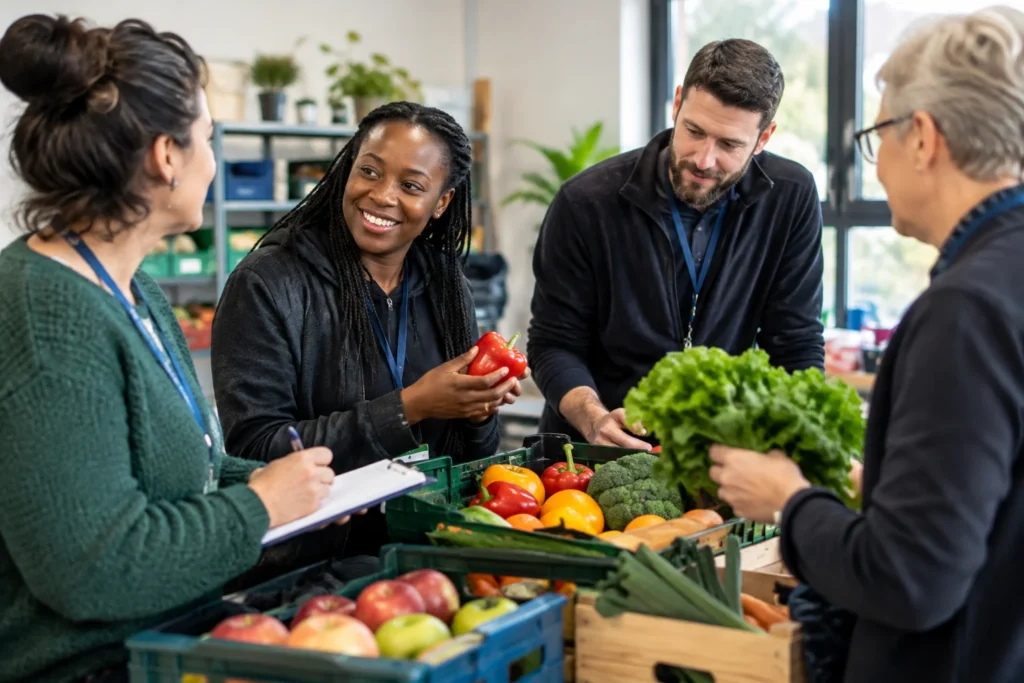
More than 55 organisations and groups were represented, according to the council. Named participants included the NHS, the Obesity Health Alliance, the Health Equalities Group, The Brick and Fur Clemt. The figure concerns represented organisations and groups, not individual attendance.
The breadth is relevant to a food agenda because public institutions, commercial suppliers and community groups encounter different parts of it. A school or hospital is a food purchaser and catering setting; a community food project works directly with people seeking affordable groceries. Their knowledge can inform different decisions within a shared discussion.
Sustainable Food Places also emphasises coordination. Its programme description explains that coordinators convene stakeholders, help develop shared plans and communicate activity. It sees local authorities as important partners because their responsibilities span public health, procurement, planning and economic policy. These are the institutional connections behind a food-system approach, not functions assigned to a named Wigan participant at the launch.
Food access and Wigan’s earlier advertising policy
Affordability is one part of the local agenda; the surroundings in which food is promoted are another. Wigan’s 29 January 2026 public-health column on ethical advertising provides a concrete example of action that predates the partnership.
The council described restrictions on advertising for foods high in fat, sugar or salt on council-owned land. Its wider ethical approach also covers promotion of gambling, e-cigarettes, alcohol and payday loans. The policy concerns advertising space under council control, not a general ban on products sold by local shops.
The January account also records work with Curious Minds, in which young people discussed how advertising affects their physical and mental wellbeing. Their involvement forms part of the council’s stated approach to developing campaigns with communities.
That earlier policy and the new food forum operate at different points. Advertising policy concerns public messages; the partnership’s launch agenda includes the affordability and availability of food itself. Keeping both in view gives the health discussion a local policy basis, without turning the article into personal dietary advice or claiming a measured result from the new partnership.
From preventing surplus to recycling food waste
Food redistribution and waste recycling have different jobs. Defra’s food and drink hierarchy, updated in January 2024 places prevention first, followed by redistribution of edible surplus. Recycling through anaerobic digestion or composting appears further down the hierarchy, with disposal the least preferred option.
The guidance applies across organisations handling food, including producers, manufacturers, retailers, hospitality and local authorities. It encourages recording surplus and waste so organisations can identify where it arises. That gives the partnership’s waste ambition a practical context: using more food for its intended purpose and managing what remains are connected tasks.
Wigan already describes a household route on its food-caddy information page. Residents collect leftovers and peelings for the green bin. The council says the mixed garden and food material goes to an in-vessel composting facility, matures and is used on British farms to improve soil.
The page lists suitable material such as fruit and vegetables, bread, pasta, rice, tea and coffee grounds, meat and bones. It excludes packaging, plastic bags, liquids and cooking oil. This is the existing council collection information; the partnership launch is a separate development. Edible surplus shared by community organisations remains a food-access activity, while composting provides a route for collected food and garden waste.
Existing local experience: The Brick and Fur Clemt
The two local food organisations named at the launch bring experience that was established before the new forum. Their own descriptions show how affordability, choice and surplus use can intersect in practice.
The Brick describes its Food Community at St George’s Church, Water Street as a shop-style setting where members choose groceries for a small charge. Its range includes fresh, chilled, frozen and long-life food. The charity distinguishes this model from a conventional food bank, although it sometimes provides emergency food.
Its published approach links affordable shopping with dignity and choice. Supplies include donations and diversions from national supply chains, such as supermarket or restaurant surplus. Members can also receive support and signposting. The charity places this within a preventative approach to food insecurity, rather than treating groceries as the only issue affecting a household.
Fur Clemt describes itself as a community interest company using profits to support its project and community. Its account of its origins dates the start to August 2014, a response to holiday hunger involving The Brick, Wigan Parish Church and Food Positive. It opened a permanent Real Junk Food café in July 2015.
The organisation collects edible surplus from suppliers and makes it available through cafés, food outlets and sharing arrangements. It also describes working with other community groups on smaller pantries across the borough. Its stated environmental purpose is important: the food-sharing model is intended to reduce waste as well as food poverty.
These accounts give the partnership an existing local foundation. They show organisations already connecting food distribution, community relationships and support. Current membership, opening and access arrangements remain on each organisation’s own pages; they are not new conditions introduced by the partnership.
The Sustainable Food Places framework
The council says the collective has taken initial steps towards Sustainable Food Place recognition. The national programme offers a framework for this kind of collaboration, linking food access with the local economy, public decision-making and environmental work.
Sustainable Food Places is a partnership programme led by the Soil Association, Food Matters, Sustain, Food Sense Wales and Nourish Scotland. It works with food partnerships across towns, cities, boroughs, districts and counties.
Its six-key-issues framework covers six connected areas:
- Governance and strategy: representative partnerships, shared priorities and local action plans.
- A good food movement: public awareness and community participation.
- Healthy food for all: dignified, equitable access to nutritious food.
- A sustainable food economy: development of local food businesses.
- Catering and procurement: purchasing and supply-chain practices.
- Food for the planet: sustainable production, environmental protection and reduced waste.
The framework helps explain why a food partnership includes more than food-aid organisations. Business development and institutional purchasing sit beside community participation and environmental activity. It encourages areas to consider the links between these subjects when developing policy and projects.
The Sustainable Food Places awards programme recognises places demonstrating positive change through an integrated approach. Applications are open to members of the national network, and the programme publishes guidance and previous winning applications. Recognition is therefore a separate stage from convening a launch event. Wigan’s announcement reports work towards it, not an award already received.
Community participation planned for 2027

The council plans community roadshows across the borough in 2027. It says residents and organisations will be able to share experiences and influence the work. Dates, venues and booking arrangements were not included in the 23 October announcement.
The immediate local picture is a new coordinating forum alongside existing food organisations and council policies. The roadshows are intended to widen that conversation beyond the organisations present at The Edge. Later council updates will provide the practical participation details as the programme develops.
Sources
- Wigan Council: partnership launch, 23 October 2026
- The Brick: Food Community
- Fur Clemt: project history and food sharing
- Wigan Council: ethical advertising, 29 January 2026
- Sustainable Food Places: six-key-issues framework
- Sustainable Food Places: how partnerships work
- Sustainable Food Places: awards
- Defra: food and drink surplus/waste hierarchy
- Wigan Council: food caddies and recycling