
The University of Salford reported Very High Engagement for Working with Business on 7 October 2026. Its KEF6 results also showed improvement in Local Growth and Regeneration, alongside documented engineering and building-technology partnerships.
University collaboration in focus
The University of Salford reported Very High Engagement for Working with Business in its KEF6 results on 7 October 2026, maintaining a result above its peer-cluster average. It also reported improvement in Local Growth and Regeneration. The findings describe university engagement, not an overall ranking or a measure of commercial returns for individual partners.
The cover and article images are AI-generated illustrations of generic scenes related to this topic.
Salford’s KEF6 results announced on 7 October
Salford’s business engagement was the strongest band highlighted in its announcement. The university separately reported High Engagement in Research Partnerships, Public and Community Engagement, Continuing Professional Development and Graduate Start-ups, and IP and Commercialisation.
Local Growth and Regeneration moved from Low Engagement to Medium Engagement. In its announcement of the engagement results, Salford identified Innovation Accelerator-funded projects as the biggest contributors to growth in that perspective.
It named Future Homes, the Centre for Digital Innovation and the MediaCity Immersive Technologies Innovation Hub. The announcement does not quantify each project’s contribution to the change.
How the Knowledge Exchange Framework measures engagement
Research England’s Knowledge Exchange Framework examines how English universities exchange knowledge with businesses, public bodies and communities. Its seven perspectives cover Research Partnerships; Working with Business; Working with the Public and Third Sector; Continuing Professional Development and Graduate Start-ups; Local Growth and Regeneration; IP and Commercialisation; and Public and Community Engagement.
Each perspective receives a quintile score from one to five. Quintiles divide results into five groups, with five indicating Very High Engagement. Results appear alongside an average for a cluster of similar institutions.
Research England’s explanation of KEF6 makes clear that this is not a league table. Peer clusters provide context; they are not themselves ranked. Salford’s business engagement result therefore needs to be read within its particular perspective and comparison group.
The principal KEF6 data window covers 2022–23, 2023–24 and 2024–25. Most metrics come from the Higher Education Statistics Agency’s Higher Education Business and Community Interaction survey. Innovate UK business data and Elsevier co-authorship data supplement that information.
The technical notes describe KEF2 to KEF6 as five generally comparable iterations because the underlying methodology is unchanged. Some institutions have changed clusters, however, which matters when interpreting comparisons over time.
Public and Community Engagement also uses carried-forward KEF3 self-assessment information, rather than a fresh annual assessment. The results should not be read as a record of activity undertaken only in October 2026.
Research England describes the framework’s purposes as helping universities improve knowledge exchange, supporting effective use of public funding and making expertise more visible. Its overview of the framework explains that wider purpose.
The long-running engineering partnership with Farrat
One documented example behind the wider story is Salford’s relationship with Farrat Isolevel Ltd. The Altrincham-based company works on vibration and thermal-energy control for buildings and industrial machinery.
Its specialist areas include building acoustics, industrial vibration and load-bearing thermal bridges: structural connections that can conduct heat through a building’s insulating envelope.
Salford announced a Memorandum of Understanding with Farrat on 21 August 2025. The agreement was intended to strengthen an existing partnership and support further collaboration. It was not a new agreement signed for the October 2026 KEF6 results.
The university’s account of the Farrat agreement describes multiple Knowledge Transfer Partnerships, sponsored PhDs, site visits, masterclasses and guest lectures. These connected the company with Salford’s acoustics and Energy House Labs expertise.
Salford also reported Farrat’s sponsorship of a Sustainable Sound Futures doctoral project. Through Friends of Energy House, the company supported the Pemberton Scholarship Programme, sponsoring one undergraduate and three postgraduates over three years.
The relationship predates the agreement by several years. In the announcement, Salford’s Janet Morana traced her first KTP application with Farrat to September 2016.
A historical REF 2021 impact case study describes a Farrat partnership applying Salford’s in-situ blocked-force method to buildings. The approach characterises vibration sources so simulations can estimate transmitted vibration and resulting noise, supporting mitigation design. This is evidence of earlier research translation, not a new October 2026 outcome.
Turning thermal-bridge research into practical tools
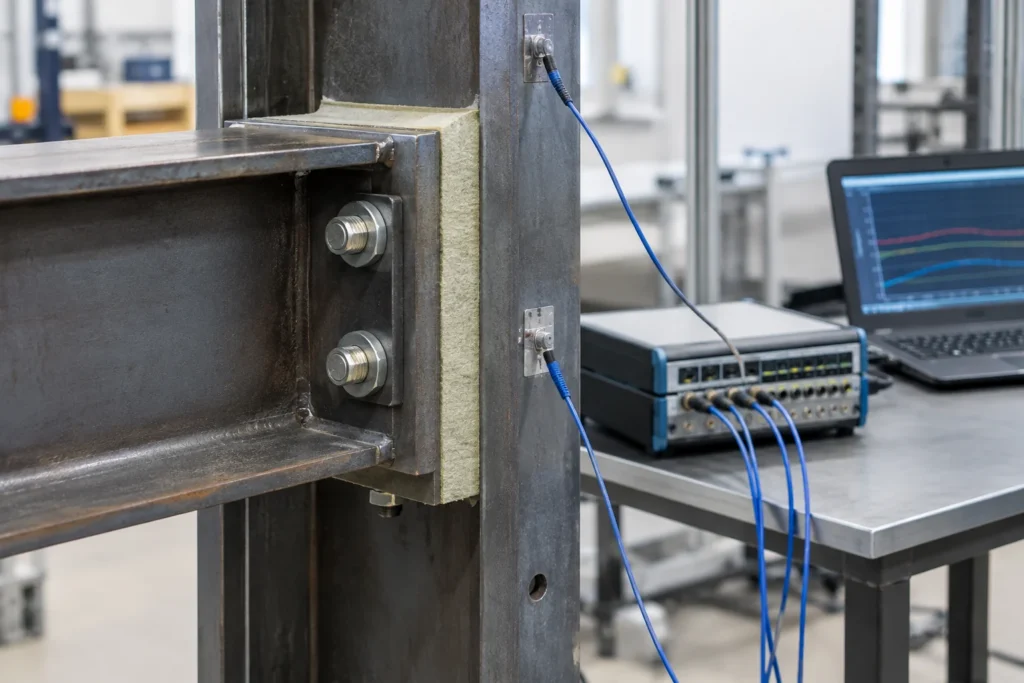
Farrat’s thermal-performance work provides another example of how academic research can move towards practical use. According to the company, it began with a sponsored PhD examining structural steel connections where they pass through a building’s thermal envelope.
The thermal envelope is the boundary separating the building’s internal environment from outside conditions. Steel connections crossing that boundary can provide a path for heat transfer, making their detailed design important to overall performance.
Farrat says the research compared theoretical thermal models with real construction and identified a gap between designed and actual connection performance. A subsequent KTP with Salford’s Energy House team sought to translate those findings into practical applications.
The partnership combined academic supervision, research facilities and a full-time KTP Associate. In its account of the completed thermal-performance project, Farrat reports practical tools and a specialist consultancy offering supporting thermal-break adoption and complex structural-connection detailing.
Farrat also reports that Innovate UK assessed the completed project as Very Good. That assessment concerns this particular partnership. It is separate from the university-level engagement bands presented in the KEF6 results.
Business collaborations beyond building physics
Salford’s business engagement extends beyond construction research. On 25 August 2026, the university reported Very Good Innovate UK assessments for five KTPs involving KP Acoustics, Greenjets, Valves Instruments Plus, Farrat and Irwin Mitchell.
A Knowledge Transfer Partnership brings together a business, a university and a dedicated Associate, with part-funding from Innovate UK. Salford says it participated in the programme’s original university pilot in 1975.
The university’s report on the five assessed partnerships describes several different applications of research. KP Acoustics developed a prototype adaptive soundscape system combining acoustics and human-perception research to create personalised workplace sound environments. Its reported status was a prototype, not a widely deployed product.
Greenjets developed tools for predicting and mitigating electric-propulsion noise during early design. The stated applications include drones and future aircraft. This illustrates how specialist acoustic knowledge can inform design before a product reaches operational use.
Valves Instruments Plus worked on adopting Building Information Modelling, which uses digital information to support construction design and delivery. The project aimed to help the engineering supplier’s products be specified earlier in construction projects.
Irwin Mitchell’s partnership developed machine-learning tools and in-house data-science expertise for legal-service delivery and business decision-making.
Future Homes testing and support for innovators
Future Homes provides a more detailed account of building-product testing and business support. Its published first phase ran from 1 April 2023 to 31 March 2025, overlapping the principal reporting window for KEF6.
The Future Homes project information records £3.54 million in Innovate UK support and reports 52 product evaluations and business assists during that phase. This is a combined activity total, not a count of 52 separate businesses.
Within the New Build and Retrofit work package, the page reports 41 business assists/product evaluations across Energy House 1, Energy House 2.0 and the Acoustics Lab. It says 83% of beneficiaries had not previously worked with Salford. Those figures belong to that work package, rather than all university partnerships.
Phase-one partners included Barratt Redrow, Bellway Homes, Saint-Gobain, Q-Bot, Red Co-operative, RSK Environment, the Energy Innovation Agency and the universities of Manchester and Salford.
The project describes testing and verification for new-build and retrofit technologies at Technology Readiness Levels 4–6. These levels concern development and demonstration before full commercial deployment. The stated purpose was to support progress towards market launch, not guarantee commercialisation.
Its research themes include heating and controls, building fabric, ventilation, indoor air quality, overheating, heat-pump acoustics and digital retrofit assessment. Several extension activities are described as plans, so they should not be counted as completed work.
The published lessons emphasise comparing building models with measured performance and simplifying smart-home controls. They also highlight the need to consider energy efficiency, ventilation, acoustics and overheating together, rather than treating each issue separately.
The figures above describe the dated first phase. They do not establish that funding, applications or assistance remain available on 24 October 2026.
What the results mean for local businesses
The KEF6 results provide a structured view of Salford’s engagement, while the documented projects explain what collaboration can involve. Technical testing, doctoral research, staff expertise and prototype development are different routes, with different outputs.
The distinction matters: an engagement band summarises institutional activity, while a project account explains particular work. For businesses exploring the building-technology research discussed here, the linked Future Homes information provides a useful next step for understanding its published scope.
Sources
- University of Salford maintains continued success in the Knowledge Exchange Framework for innovation with partners | University of Salford
- KEF6 results show growth in university knowledge exchange outcomes – UKRI
- Research England: KEF Technical Notes
- www.ukri.org
- MOU between Salford and Farrat Isolevel Ltd confirms strengthening partnership | University of Salford
- results2021.ref.ac.uk
- Farrat x University of Salford KTP Awarded ‘Very Good’ – Farrat
- Five University-business partnerships receive Innovate UK ‘Very Good’ grading | University of Salford
- Future Homes Project (2023-2026) | Energy House Labs | University of Salford