

A 19 October 2026 NHS profile highlights Sarah Ashworth’s move from nursing into Bolton’s inventory programme. The feature explains the documented pilot, scanning technology and national context.
Clinical experience behind digital stock management
Former nurse Sarah Ashworth is leading Bolton’s hospital inventory programme as Genesis Programme Manager with iFM Bolton, according to an NHS profile published on 19 October 2026. Her work brings clinical experience into a programme intended to improve stock management, traceability and patient safety.
The cover and article images are AI-generated illustrations of generic scenes related to this topic.
From bedside nursing to leading Bolton’s inventory programme
Ashworth became a nurse in 2003, inspired by the care her grandfather received at Royal Bolton Hospital. She went on to spend more than 15 years in nursing, including work in theatres and the Emergency Department.
That background matters because hospital supplies are not simply purchasing records. The people choosing and managing them must understand how clinical teams use products during care. Ashworth’s subsequent procurement work involved theatre teams, medical devices and supplier contracts, allowing her to draw on that practical knowledge.
The trust’s profile of Ashworth’s career and programme role identifies her employer as iFM Bolton, its estates and facilities partner. It says the opportunity to lead the Genesis rollout arose in 2024.
Ashworth presented Bolton’s inventory programme at a GS1 conference in London alongside her line manager, Nikki Kenny. The profile describes the presentation as part of her professional development; it does not establish a conference date.
Bolton’s hospital inventory programme: pilot and rollout plans
NHS Supply Chain’s December 2025 inventory management update lists Bolton NHS Foundation Trust among pilot trusts already using inventory management with point-of-care scanning. This provides separate confirmation of participation beyond the later staff profile.
Point-of-care scanning records products where they are used in care. Its inclusion in that update establishes more than an aspiration to introduce an inventory system, but does not show that every department had adopted it.
How scanning connects hospital stock with patient care
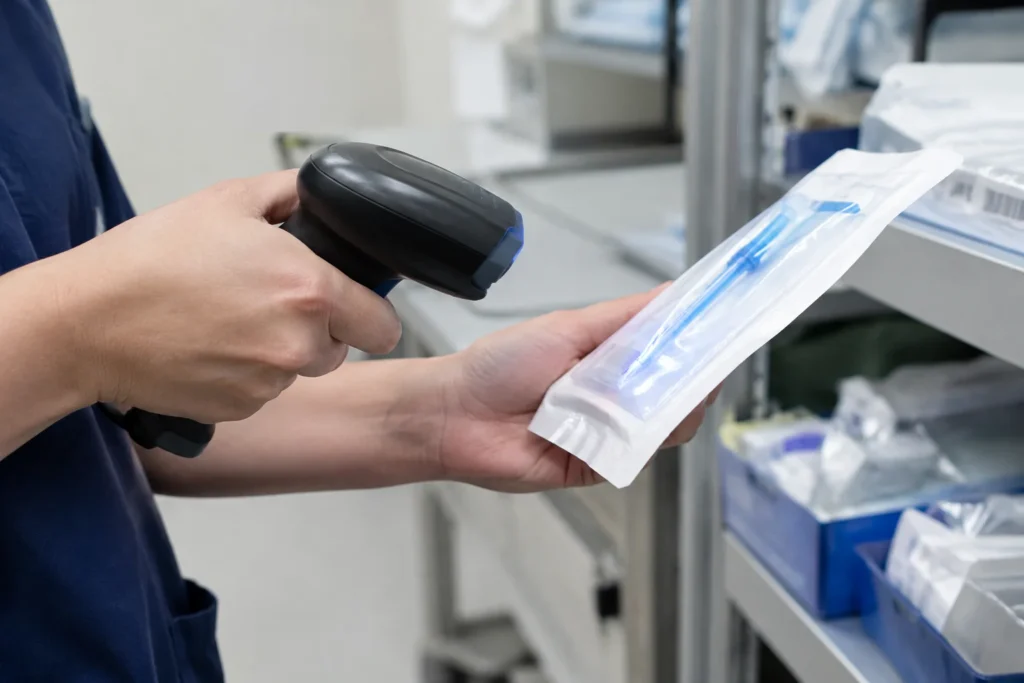
The technology helps explain the hospital inventory programme’s purpose. Genesis’s inventory product description sets out a shared view of supplies and locations for clinical, supply-chain and financial teams. The capabilities below are the supplier’s description, not confirmation that every function operates in Bolton.
At receipt, Genesis describes scanning that captures lot, serial and expiry information. A lot identifies a production batch; a serial number identifies an individual item. Recording those details supports tracking beyond a product name or quantity.
The supplier also describes checks for discrepancies against purchase orders. Location tracking can cover storerooms, theatres, wards and consignment shelves, using mobile or handheld scanning. This connects the record of an item arriving with its subsequent position inside a hospital.
For replenishment, the system uses consumption information and supplier turnaround to recommend further stock. Genesis also describes automatic purchase-order generation for named enterprise systems. That functionality should not be read as evidence of particular integrations or ordering arrangements within Bolton’s inventory programme.
At use, the supplier describes expiry and recall checks, alongside consolidated warnings. Its description retains clinical judgement as the final authority. Supplies can also be associated with a patient, case and cost centre, connecting clinical activity with financial records.
For recalls, Genesis describes identifying affected lots or serial numbers, locating stock on shelves and identifying patients associated with affected products. It also says owned, consigned and trial stock can be managed together.
These functions explain the connection between receiving goods, managing stock and tracing products used during care. They do not demonstrate that the Genesis rollout has delivered a particular reduction in errors, waste or costs in Bolton. Such findings would require local evaluation rather than a product specification.
The national inventory programme in context
Bolton’s hospital inventory programme sits within a wider NHS effort to connect stock visibility with point-of-care scanning. NHS Supply Chain estimates that the NHS holds more than £1 billion in shelf stock, illustrating the scale of the inventory-management task.
Its April 2026 national programme update reported 19 trusts live across 83 locations. Those locations covered 12 clinical specialities and more than 30 theatres and laboratories. These are April figures, not a measurement of the position in October.
The same update reported £15.3 million captured over 18 months across wastage, reduced overstock, obsolescence and rationalisation. It also reported an average of 700 clinical hours saved annually per trust.
Those are NHS Supply Chain’s programme-level results. They cannot establish Bolton’s savings or released clinical time, and the average should not be treated as a local result. No Bolton-specific outcome figure is established here.
The national approach also includes community working groups. These draw on early adopters, trusts already using inventory systems and the wider integrated care system community to share implementation experience.
Beyond the pilot, NHS Supply Chain describes an intention to support trusts’ inventory management over the following five years. It identifies reduced expiry waste, better demand forecasting and consolidated deliveries as sustainability opportunities.
The clinical, supply-chain and data work behind implementation

NHS Supply Chain’s December 2025 guidance shows why a hospital inventory programme needs several disciplines. It describes a local delivery team spanning clinical operations, supply chain, IT and data. This is programme guidance, not a verified organisation chart for Bolton.
The project manager is responsible for planning, resources and delivery coordination. The role also includes managing risks with trust stakeholders and NHS Supply Chain. That places the work across organisational boundaries rather than within a single stockroom or clinical department.
The clinical lead contributes to solution design and decisions about stock levels. The guidance also assigns this role assurance during organisational change and identification of implementation risks. Recommended experience includes knowledge of products and procedures, plus the ability to influence colleagues.
Supply-chain leads have a different remit. They help document existing arrangements, make process and integration decisions and establish departmental materials management. IT and data leads coordinate data extracts and integration while helping maintain supply processes through the transition.
The guidance requests purchasing and invoice data, together with stock audits, to establish costs and holdings. Optional anonymised theatre activity data can help assess capacity and demand when prioritising point-of-care implementation.
A separate national framework for systems and hardware
A separate national procurement arrangement provides further context, but not evidence of Bolton’s contract. As at 24 October 2026, NHS Supply Chain lists its Scan4Safety framework for systems and hardware as running from 26 June 2026 to 25 June 2030.
The framework lists 13 suppliers, including Genesis Automation (UK) Limited. It separates inventory management, point-of-care scanning, combined systems and supporting hardware into different lots. Its scope also includes training and consultancy options.
The systems lots require further competition. Direct award is available only for the hardware lot, subject to applicable requirements. These arrangements distinguish buying software and associated services from obtaining the devices used to operate them.
Listed supplier requirements cover carbon reduction plans, Evergreen assessment, modern slavery assessment, social value and the NHS England net zero supplier roadmap. They are framework requirements, not evidence of particular outcomes in Bolton.
The framework’s existence and supplier list do not establish Bolton’s purchasing route, procurement date or contract value. Its 2026 dates also should not be used to explain decisions made earlier in the Genesis rollout.
Sources
- From nurse to programme manager: Driving healthcare change across Bolton – Bolton NHS Foundation Trust
- Genesis: Automate Clinical Supply with Full Traceability
- www.gs1uk.org
- Inventory Management System (IMS) – Update December 2025
- In-Trust Inventory Management Systems (IMS) » NHS Supply Chain
- Scan4Safety (IMS Direct Framework Agreement) – NHS Supply Chain