
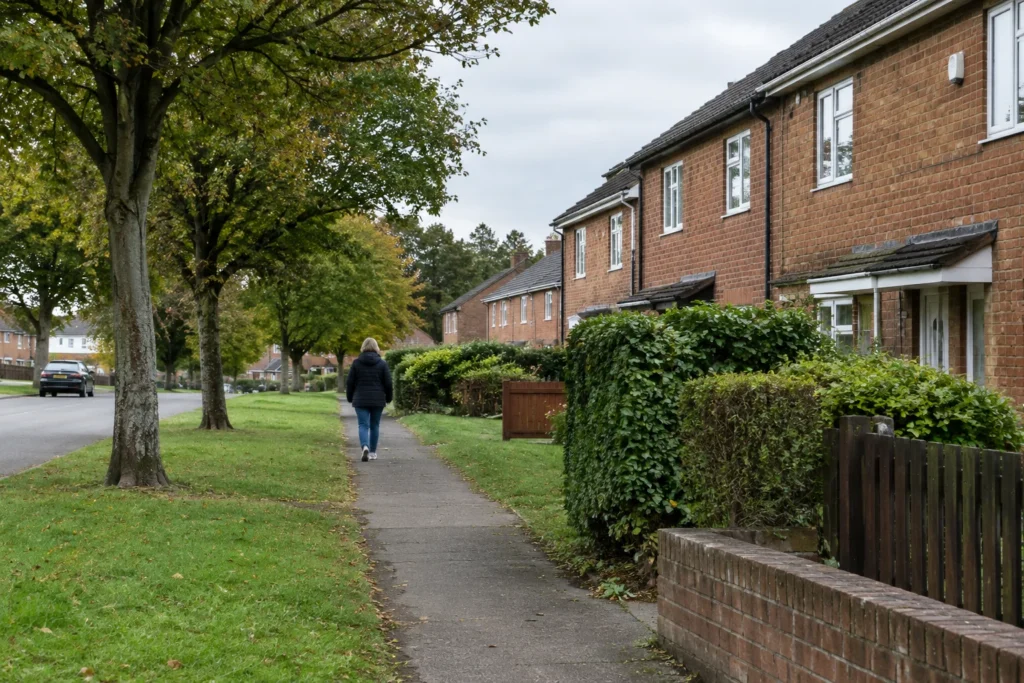
Tameside’s decisions advance Hattersley’s £20m programme through board governance, capacity funding and draft-plan authorisation, rather than approval of named building projects.
What the decisions mean for residents
The Hattersley neighbourhood programme has advanced through decisions on its board, early funding and draft planning. Tameside’s Executive Cabinet approved board governance, Laura Nicholas’s appointment as chair, acceptance of capacity funding and submission of a draft Regeneration Plan. These are preparatory decisions for the £20m programme, not approval or delivery of a named building project.
As at 24 October 2026, the latest verified local decision was made on 30 September. It establishes responsibilities and authorises further work, while leaving specific investment choices to the planning process.
Hattersley neighbourhood programme: what Cabinet approved
The published Cabinet decision records several distinct actions. Cabinet approved the board’s terms of reference, which provide its governing framework. It also approved Laura Nicholas’s appointment as chair.
On funding, Cabinet agreed to accept £390,000 in capacity funding. This brought the council’s recorded capacity allocation to £540,000. The Director of Strategic Growth was authorised to manage the associated programme of works.
Cabinet also approved submission of a draft Regeneration Plan to the Ministry of Housing, Communities and Local Government. Authorisation to submit is a formal step, but it is different from confirmation that submission has happened or that government has accepted the plan.
The wording matters elsewhere in the resolution too. Cabinet noted the board’s membership, its establishment and the defined programme boundary. Those matters were recorded as noted, rather than separately approved in the same terms as the chair’s appointment or funding acceptance.
There are three relevant dates. Cabinet made the decision on 30 September 2026; it was published on 1 October; and it became effective on 9 October. None of those dates should be mistaken for a construction start or a funding payment date.
For residents, the practical significance is a clearer structure for developing the programme. There is an appointed chair, an agreed governance framework and authority to use early funding. The recorded resolution does not identify a named capital scheme as approved, procured or completed.
The decisions therefore cover governance, resources for preparation and the route towards a plan. Those are separate parts of programme development. Reading them together explains why the announcement represents progress without yet setting out a construction programme for the neighbourhood.
How the £20m programme and capacity funding fit together
Hattersley Pride in Place funding
Hattersley Pride in Place sits within a national offer of up to £20m in funding and support per neighbourhood over ten years. That headline describes the overall programme, not a sum already available in full to spend locally.
The council’s Hattersley report describes the funding split as 63% capital and 37% revenue. These are different categories of expenditure, not allocations to named local projects. Capital funding generally supports assets, while revenue funding supports non-capital expenditure.
The same report records £150,000 in initial capacity funding and a further £390,000, giving its rounded total of £540,000. Capacity funding supports the early work needed to develop and organise the programme. It should not be added to the £20m headline as a separate bonus.
National delivery guidance includes early capacity and delivery funding within the overall offer. Its phase-two profile totals approximately £19.6m in direct funding. The council’s rounded figures and the national profile use different levels of precision; they do not establish an additional funding award.
The funding timetable also carries conditions. Allocations after 2028/29 are subject to the next Spending Review. The council report’s expectation of a payment in April 2027 is a forecast, not confirmation of receipt. Earlier capacity and early delivery payments are separate categories within the programme timetable.
Spending over the programme’s lifetime
Under the national rules, annual underspends can roll forward, but future allocations cannot be drawn down early. Boards are expected to spend at least 25% of each investment period’s cumulative allocation, and 50% of cumulative allocations by the end of year seven.
These rules allow unspent annual funding to move forward without allowing later years’ allocations to be brought forward. They also establish spending expectations across the investment periods, rather than treating the entire ten-year offer as immediately accessible.
These requirements make the distinction between an allocation and actual spending important. A ten-year offer provides a planning framework, while expenditure must still follow the programme’s timetable, conditions and investment decisions.

Who leads the neighbourhood board
Laura Nicholas chairs the Hattersley neighbourhood board. The council’s September announcement describes the board as bringing together people from the community, business and voluntary sectors.
In that announcement, Nicholas described listening to residents, businesses, community groups and young people as the immediate priority. That places engagement at the start of deciding how the programme should develop, rather than presenting a completed package of projects.
Hattersley neighbourhood board representation
The council report sets out a minimum of eight board members and says at least 51% should live or work in the area. It describes the chair’s role as voluntary, with reasonable expenses available.
National requirements add further representation rules. The local MP and at least one ward councillor must sit on the board. Residents and local workers must outnumber elected representatives, maintaining a community majority alongside political representation.
These are overlapping requirements, not interchangeable descriptions. The minimum membership sets the board’s size. The local connection requirement and the balance with elected representatives address who participates in its decisions.
The Hattersley neighbourhood board therefore has a different role from the council acting as accountable body. Its membership brings local perspectives into the programme, while the council retains the financial responsibilities attached to receiving and administering public funding.
The representation requirements explain who should have a voice, but they do not establish that every resident or business supports a particular proposal. The board’s engagement work and subsequent investment planning are the processes through which competing priorities must be considered.
How residents and businesses inform investment priorities
The council’s 9 September announcement launched engagement events and a public survey. Their stated purpose was to inform the long-term vision and future investment priorities for Hattersley.
The announced survey deadline was Sunday 4 October 2026. That date has passed. As at 24 October 2026, no extension, response totals, published consultation findings or agreed investment priorities had been verified.

The survey was one part of a wider participation requirement. The national prospectus calls for extensive, sustained engagement, particularly with people previously excluded from decision-making. Boards must provide evidence of that engagement when submitting their plans.
They must also explain subsequent progress, or barriers to progress, to the communities they consulted. Collecting views is therefore not the whole requirement: the national framework expects a continuing relationship between consultation and reporting back.
The prospectus identifies groups whom conventional consultation may not reach. These include people without internet access, people who do not speak English and older people. Local community organisations can help boards reach beyond the people most likely to respond through usual channels.
For local businesses, participation is intended to contribute knowledge and priorities, alongside residents and community groups. It does not establish a promise of contracts or commercial benefits. For residents, the important distinction is between being asked for views and seeing those views reflected in an agreed plan.
Hattersley Pride in Place must connect that local engagement with its investment proposals. Published findings would help explain that connection, but the September announcement itself does not establish the eventual choices.
From the shadow board to the investment plan
The planning framework requires a ten-year vision and an initial four-year investment plan. The vision sets the longer-term direction; the investment plan sets out the first period of proposed spending.
The national delivery guidance then provides for two further three-year investment periods, with refreshed plans. The ten-year programme is therefore not a single fixed spending document covering every later decision.
For the 160 phase-two boards in the earlier submission group, national guidance sets a deadline of 30 November 2026. That is the deadline’s stated scope, rather than a universal date for every neighbourhood in the programme.
For Hattersley, Cabinet’s authorisation to submit a draft plan should remain distinct from evidence of actual submission or government acceptance. Neither step alone would demonstrate procurement or delivery of a particular project.
The council report also records minor boundary amendments, and Cabinet noted the defined boundary. Those statements do not establish the precise street-level changes or whether an individual address is included. A general description of amendments cannot substitute for the detailed boundary map.
Financial accountability and community-led delivery
Tameside Council is the accountable body for the Hattersley neighbourhood programme. This gives it responsibilities for financial administration and reporting that are distinct from the board’s role in shaping local priorities.
National delivery guidance requires accountable bodies to submit monitoring returns every six months, in April and October. Their chief finance officers must also provide annual statements covering grant usage. These requirements provide a recurring reporting framework, rather than relying solely on the initial approval of a plan.
The national programme prospectus expects a transition towards community-led delivery by year three. It describes several possible arrangements, including an existing community organisation acting as an anchor.
Other possibilities include a board becoming a co-operative, community interest company or charity. These are national options, not confirmation that Hattersley has selected a legal structure or transferred delivery responsibilities to a particular organisation.
The national framework thus addresses both public financial oversight and the longer-term role of community organisations. The expectation of community-led delivery should not be confused with evidence that a particular organisation already controls Hattersley’s programme funding.
The next evidence to look for is actual plan submission and acceptance, published engagement findings and specific investment decisions. Those records would show how the governance and early funding decisions translate into agreed local activity.
For now, the Hattersley neighbourhood programme has progressed through formal preparation. Residents following its development should distinguish those documented steps from later decisions about what will be funded, when work will begin and what has been delivered.
Related reading
Frequently asked questions
What did Cabinet approve for Hattersley?
Cabinet approved the board’s terms of reference, Laura Nicholas’s appointment as chair, acceptance of £390,000 capacity funding and submission of a draft Regeneration Plan. This was not approval of a named construction project.
Is Hattersley’s £20m funding available immediately?
No. The national offer provides up to £20m in funding and support over ten years, subject to allocations and conditions. It is not an immediate £20m payment.
Is the £540,000 capacity funding extra to the £20m?
No. The council records an initial £150,000 and a further £390,000 in capacity funding. National guidance includes early capacity and delivery funding within the overall programme offer.
Who chairs the board, and who should be represented?
Laura Nicholas chairs the Hattersley neighbourhood board. It brings together community, business and voluntary representatives. National requirements include the local MP, at least one ward councillor and a majority of members who live or work in the neighbourhood.
Can residents still complete the announced survey?
The announced deadline was Sunday 4 October 2026, which has passed. As at 24 October 2026, no extension or published survey results had been verified.
What plans does the programme require?
It requires a ten-year vision and an initial four-year investment plan, followed by refreshed plans for two further three-year investment periods.
Has the programme boundary changed?
The council report records minor boundary amendments, and Cabinet noted the defined programme boundary. These records do not establish the precise street-level changes.
Who is accountable for the money?
Tameside Council is the accountable body. National guidance requires six-monthly monitoring returns in April and October, plus annual grant-usage statements from the accountable body’s chief finance officer.