
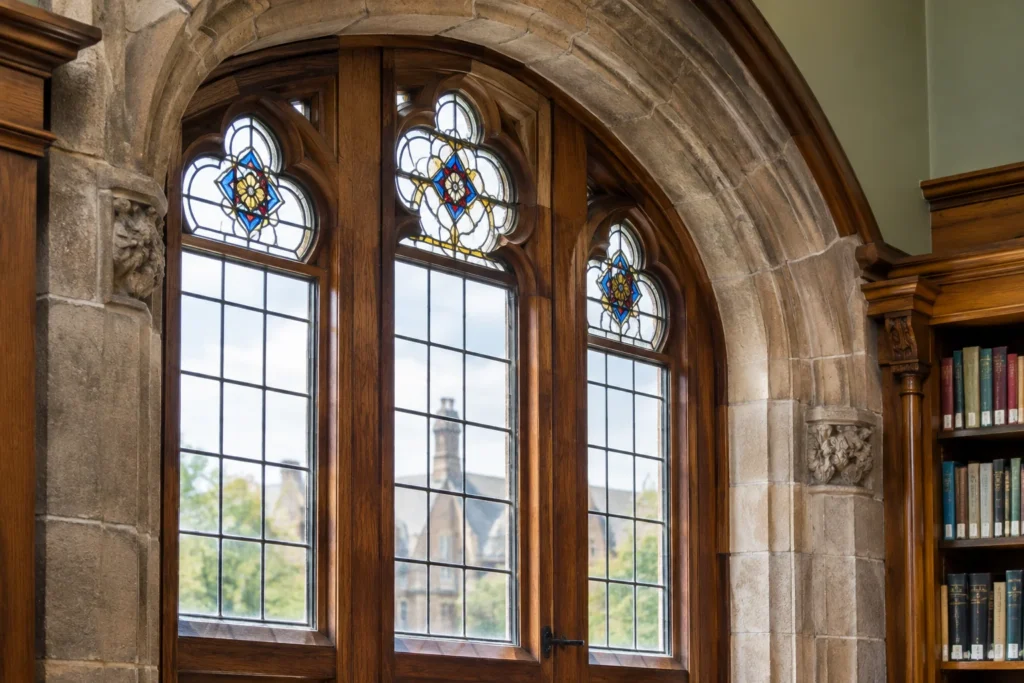
Oldham’s restored Old Library has won two national construction awards, recognising its heritage restoration and renewed civic, cultural and community uses.
National recognition for an Oldham landmark
Oldham’s J.R. Clynes Building has won Cultural and Leisure Project and Retrofit and Reuse at the British Construction and Infrastructure Awards. The ceremony took place on 14 October 2026, and Oldham Council announced the results on 16 October. The awards recognise the completed restoration of the former Old Library, not a new opening that month.
The Old Library restoration brought together historic architecture and renewed civic, cultural and community uses. It combined conservation work with modern services, a glass lift and adapted internal spaces. The double award offers a reason to look beyond the announcement: at what was retained, how the brief changed and which activities the building was adapted to accommodate.
The cover and article images are AI-generated illustrations, rather than photographs of the J.R. Clynes Building or its project team.
Two construction awards for Oldham’s restored library

The result recognises the same restoration in two distinct categories. One concerns a cultural and leisure project; the other concerns retrofit and reuse. Both winning entries appear in the awards organiser’s 2026 results, confirming the outcome separately from the council’s announcement.
Oldham Council’s announcement of the two awards, published on 16 October 2026, identifies the former library as the building receiving the recognition. It describes a historic property on Greaves Street that has been restored and adapted, rather than replaced by a new development.
The category names draw attention to different aspects of Oldham’s restored library. Cultural use concerns the activities accommodated within the renewed building. Reuse concerns adapting an existing structure and the work needed to make that possible. These are useful ways to understand the categories, rather than a substitute for the judges’ published assessment.
For local readers, the immediate significance is recognition of an established civic asset. The historic library restoration has a documented story of its own: an older public building has been conserved, given renewed functions and recognised by a national construction awards programme.
The announcement is therefore principally about completed work. Understanding the Old Library restoration requires looking at the building’s history, the changing design brief and the practical conservation measures behind the finished spaces.
The winning categories and project team
The organiser’s winning entries identify Oldham Council as client, Ellis Williams Architects as architect, Tilbury Douglas as contractor and Curtins as engineer. Both categories name the same principal team for the Old Library restoration.
The published restoration accounts cover structural stabilisation, roofing, external repairs, interior conservation and modern services. Some of that work is readily visible in architectural features. Other elements concern the structure and infrastructure needed to support the adapted building.
From Old Library to J.R. Clynes Building
The council dates the former library to 1883 and describes it as Grade II listed. Those details explain why the Old Library restoration involved conserving an established historic building, not simply fitting new rooms into an ordinary shell.
Its earlier identity remains important. References to the Old Library and the J.R. Clynes Building concern the same restored property. The newer name does not indicate a separate construction project and should not be mistaken for the creation of a new library service.
The council’s awards announcement places the building on Greaves Street, within Oldham’s existing town-centre setting. Its architectural features formed part of the restoration work rather than merely providing a backdrop to a new interior.
The name honours John Robert Clynes, the former MP and Labour Party leader. According to the council’s account of the preview and naming event, the name was revealed on 16 August 2025. The council published that report on 19 August.
How the Old Library restoration developed
The project did not proceed under an unchanged brief from beginning to end. Ellis Williams’ project account says an original museum-and-archive proposal evolved after a strategic review. The revised scheme incorporated civic and democratic facilities while retaining cultural and community uses.
The construction sequence matters too. Earlier restoration and structural stabilisation preceded the sensitive internal fit-out described by Tilbury Douglas. Treating those as separate stages gives a more accurate account than attaching the entire project to one ceremony or announcement.
The contractor recorded a phase-two milestone event on 14 February 2024. Its announcement was published on 16 February 2024. The event date and publication date refer to different things, even though they sit only two days apart.
Phase two concerned the internal work following the earlier restoration stage. In its later account, the contractor described combining retained architectural character with new services, a glass lift and flexible spaces. That sequence connects the structural work with the rooms and features associated with Oldham’s restored library.
The next clearly dated public milestone in the council’s account is the special preview on 16 August 2025. This was also the naming event. The report published three days later said full public opening would follow later that year.
The October 2026 awards announcement refers to reopening “last August” without stating the year in that phrase. That wording alone does not settle a precise reopening date. The dated preview report provides a firmer basis for describing what happened on 16 August 2025.
Historic library restoration: fabric and modern services
The strongest practical detail in the project accounts concerns the relationship between conservation and adaptation. The architect describes roof replacement using original tiles where possible, alongside cleaning and repair of external stonework. Relief sculptures were also preserved.
Ellis Williams describes its RIBA Conservation Architect working with the council, Conservation Officer and specialist contractors. The project account records protection of Victorian features alongside discreet modern services and digital infrastructure.
Tilbury Douglas’s May 2026 restoration account adds details about stained glass, stone carvings and architectural detailing. It describes a sensitive internal fit-out following structural stabilisation, bringing retained features together with modern services and adapted spaces.
The contractor’s February 2024 account identifies carved stone heads on the east and west walls representing literature, art, music, science and engineering. It also describes the Lady Wrigley statue holding a wreath and a book.
Civic rooms, cultural space and community use
The council’s October account identifies a Council Chamber, Mayor’s Parlour, civic and community meeting rooms, a second-floor art gallery, an Oldham Theatre Workshop studio and a community garden. These are the renewed uses recorded for the J.R. Clynes Building.
The physical provision of those spaces should be distinguished from their day-to-day operation. A project description establishes that facilities are included. It does not, by itself, establish the current programme, public opening hours, admission arrangements or whether a particular room can be booked.
In the cultural-category assessment, the judges highlighted research into the gallery’s original paint colour and restoration of its historic finish. They also praised material reuse, retained heritage features and improved accessibility. This is the organiser’s assessment of the project, rather than a separate performance audit.
Local supply chains and specialist restoration work
The awards organiser’s judging account states that 75% of the supply chain came from the local area. This provides a relevant business dimension to the Old Library restoration, but the figure needs to remain attached to its source.
The published account does not define the geographical boundary of “local” or explain the calculation method. The proportion should therefore not be rewritten as Oldham-only suppliers, Greater Manchester expenditure or the value of contracts awarded within a particular boundary.
The documented work nevertheless gives a clear sense of the skills involved in historic library restoration. Roofing, stonework repair, stained-glass restoration, architectural detailing and internal fit-out all appear in the project accounts. These tasks explain the relevance of specialist construction and conservation capability.
Putting the recognition in context
The J.R. Clynes Building’s two awards bring national recognition to a completed Oldham restoration. The underlying story combines an 1883 listed building, a changing project brief, conserved architectural features and renewed civic and cultural functions.
The dates remain important. February 2024 marked a phase-two milestone; August 2025 brought a special preview and naming event; October 2026 brought the awards. These events describe the development and recognition of the project, not a single newly announced opening.
Sources
- Oldham Council: Restored Old Library opens its doors for a special preview
- Ellis Williams: Oldham Old Library — J.R. Clynes Building
- Tilbury Douglas: Phase two of Oldham Old Library restoration
- Tilbury Douglas: Restoring civic heritage at the J.R. Clynes Building
- Oldham Council: J.R. Clynes Building double award, 16 October 2026
- British Construction and Infrastructure Awards: 2026 winners