
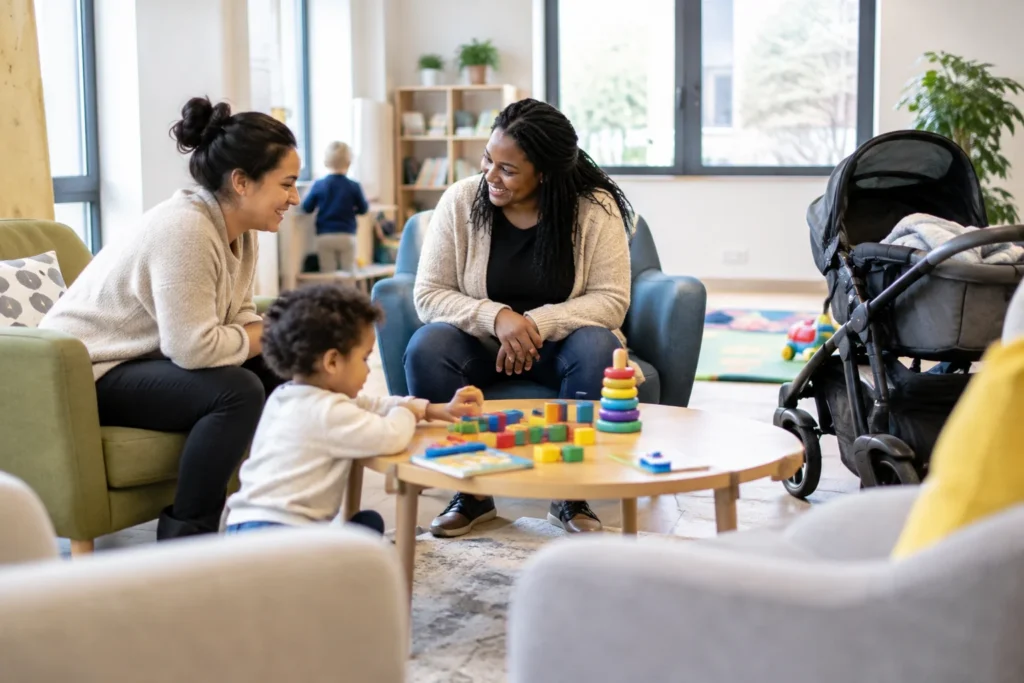
Manchester’s sixth family hub has opened at North City Leisure Centre in Harpurhey, with announced support spanning pregnancy, early learning, SEND and practical referrals.
A new neighbourhood base for family support
Harpurhey’s family hub has opened inside North City Leisure Centre on Upper Conran Street, bringing announced support for pregnancy, parenting, learning and practical referrals. Manchester City Council’s 15 October 2026 announcement identifies the Best Start in Life Family Hub as the city’s sixth. It says the hub opened that week but does not specify the exact day.
Harpurhey’s Best Start in Life Family Hub joins Manchester’s family hub network
The opening adds a north Manchester location to a network already covering Longsight, Wythenshawe, Cheetham Hill, Gorton and Clayton. For local families, the development is a neighbourhood base through which they can seek advice across several connected parts of family life.
The council’s opening announcement sets out an offer extending from pregnancy and infant feeding to school applications, behaviour and help with forms. It also includes support for children with special educational needs and disabilities, commonly shortened to SEND.
Harpurhey’s family hub is not described solely as an early-years service. The announced age range covers families with children aged 0–19, extending to 25 for those with SEND and care leavers. That breadth matters when understanding the offer: support for babies sits alongside information relevant to older children, parents and young adults.
By 23 October 2026, the council had announced the opening. Its published account establishes the location and broad support offer, rather than individual appointments or session times. The announcement does not establish a detailed session timetable, booking system or staffing list.
Support from pregnancy through the earliest years
Pregnancy information, feeding and breastfeeding guidance, perinatal mental health support and parenting groups are among the services announced for Harpurhey’s family hub. Perinatal mental health concerns wellbeing during pregnancy and after birth.
The national framework provides context for this approach. Government Healthy Babies implementation guidance focuses on the period from conception to age two. It describes a joined-up offer involving infant feeding, perinatal mental health, parent–infant relationships, health visiting and maternity services.
The guidance also includes SEND and safeguarding within that wider system. It envisages information reaching families online, in physical locations and through outreach, rather than relying on a building as the only route into support.
This national framework explains how different services are intended to connect. It does not demonstrate that every clinical service or specialist named in the guidance is based at Harpurhey. For the local offer, the council’s opening announcement remains the evidence for what has been announced.
Language, learning and preparing for school

Early language and learning, help with school applications and support with managing behaviour are included in Harpurhey’s family hub announcement. Manchester’s wider strategy provides more detail about the kinds of language and literacy support used across the city.
The Best Start in Life Strategy describes REAL literacy support for children over two. It is offered through family hubs, children’s centres and some schools, placing early learning within several familiar community settings.
The strategy also describes WellComm language screening. Parents can request screening through hubs and children’s centres without referral criteria. Follow-up includes developmental activities, linking the identification of language needs with support for a child’s next steps.
A separate programme, First Words Together, supports children under two. The strategy describes self-referral and approximately 45-minute weekly sessions over five weeks. Its focus includes communication and the relationship between a parent and infant.
They are citywide programme descriptions, not a confirmed Harpurhey timetable. The distinction keeps Manchester’s family hub network in view without implying that each programme already runs at every site. The local announcement confirms learning support, but not individual session dates or booking arrangements.
SEND support and the city’s inclusion plans
Support for children with special educational needs and disabilities is explicitly included in the opening announcement. The extended age range to 25 also makes SEND relevant beyond the youngest children using the Best Start in Life Family Hub.
Manchester’s strategy sets out further planned actions. These include specialist recruitment for hubs, parent workshops, clearer referral routes and alternative early education for children outside settings. They describe intended improvements, rather than a completed staffing or service arrangement at Harpurhey.
The strategy records 20,689 Manchester pupils with SEND in 2024/25. Speech, language and communication was the most common primary need, recorded for 6,751 pupils. These figures provide citywide historical context for the emphasis on communication and inclusion.
They are not a count of children using Harpurhey’s family hub, nor evidence of an effect caused by its opening. The pupil figures describe existing need; the strategy’s actions describe how the wider system intends to respond.
Practical help for parents and young adults
The council’s opening announcement says staff can help with forms and referrals for housing, counselling and benefits advice. Harpurhey’s family hub also has an announced information offer covering adult learning, volunteering and work experience, extending its scope beyond children’s activities.
Help with a referral is different from directly supplying the service concerned. The announcement does not mean hub staff allocate housing, decide benefit claims or personally deliver every counselling service. It identifies assistance with finding and approaching the relevant support.
Manchester’s separate care-leaver community hub service explains another part of the wider network. For ages 16–25, it describes opportunities to meet other care leavers and professionals, reconnect with services and obtain advice about housing, money, emotional wellbeing and health.
That service’s published description lists drop-ins across existing community and family hubs. It also describes using the Bee Connected App for information about social events and visiting services. These arrangements illustrate support beyond individual appointments.
They do not establish a Harpurhey drop-in timetable. The separate care-leaver service helps explain the wider age range, while its published arrangements should not be treated as a schedule for the newly opened hub.
How neighbourhood services and community partners connect
Manchester’s family hub network forms part of a wider neighbourhood approach. The Executive minutes of 16 September 2026 describe connections between early intervention, prevention and family support.
The minutes link the Best Start strategy, Family Hub Programme and Families First Partnership Programme. This places the Best Start in Life Family Hub model within a broader effort to connect services, rather than presenting each hub as an isolated project.
The September report recorded more than 20,000 attendees and 90,000 interventions accessed across four earlier sites during the preceding 12 months. These are the reported units: they are not figures for unique families, Harpurhey attendance or independently evaluated outcomes.
The minutes also describe commissioned community-led services and an expanded offer for older children. National programme funding was reported confirmed until March 2029, alongside additional investment for children with additional needs. The minutes identify a Best Start in Life Family Hub and Healthy Babies Board for strategic oversight. No Harpurhey-specific spending allocation follows from those statements.
Community participation is another part of the model. In its account of family hub involvement, Macc identifies itself as a voluntary, community and social enterprise sector member of the council’s steering group.
Macc describes engagement with community centres, parent-carer panels and programme leads, including community midwives, Dad Matters and Mum Matters. Its account explains its own participation; the October council announcement establishes the six-hub total at the time of Harpurhey’s opening. Together, these records distinguish the network’s governance, community engagement and reported activity.
The development targets behind Manchester’s wider strategy
The wider strategy sets measurable ambitions for children’s development. In 2024/25, 60.3% of assessed Manchester Reception children achieved a good level of development. Among children eligible for free school meals, the figure was 53.1%.
A good level of development concerns expected Reception outcomes in communication, personal development, physical development, mathematics and literacy. It is therefore broader than reading or counting alone, covering several aspects of a child’s early learning.
Manchester’s targets are 68.6% overall and 62% for children eligible for free school meals by 2028. By 2030, the respective targets rise to 70% and 64%. These are future citywide ambitions, not results already achieved through Harpurhey’s family hub.
The targets imply increases from the 2024/25 baseline of 8.3 percentage points overall and 8.9 percentage points for children eligible for free school meals by 2028. These comparisons show the scale of the intended change, not a forecast of what one new hub will deliver.
The dates also clarify the sequence of expansion. September’s Executive minutes noted Clayton’s opening and further hubs planned by the end of 2026. The Executive noted programme progress; that record did not establish that future openings had happened.