
NASA’s astronomy feature uses an existing computer visualisation to explore dark matter. Here is what it shows, how observations inform the models and what remains unknown.
A computer picture of unseen matter
NASA’s astronomy feature for 25 October 2026 uses a dark matter simulation to illustrate how unseen matter relates to cosmic structure. It is a computer visualisation, not a photograph of dark matter or an announcement of a new discovery.
What NASA's 25 October feature shows
The picture represents simulated dark matter as black filaments, with ordinary matter shown in orange concentrations. These colours help explain the model; they do not show what dark matter looks like through a telescope.
The visualisation also predates this feature. NASA’s Astronomy Picture of the Day entry for 20 October 2024 carries the same title, illustration credits and description. Its appearance in October 2026 is therefore an opportunity to explain an existing scientific visualisation, rather than evidence of a newly created simulation.
The dates serve different purposes: 25 October 2026 identifies this educational feature, while the earlier archive entry establishes the picture’s previous use. Neither date, by itself, dates a scientific discovery.
What dark matter is — and how dark energy differs
According to NASA, dark matter has mass and produces gravitational effects, but does not appear to absorb, reflect or emit light. Astronomers therefore investigate its influence on ordinary matter rather than identifying it by its own light.
This distinction matters when interpreting the picture. A dark filament in the visualisation is a representation of calculated matter, not a dark object captured by a camera. The image makes an otherwise unseen component of the model understandable.
NASA gives the universe’s approximate composition as 5% ordinary matter, 27% dark matter and 68% dark energy. These are shares of its overall composition, not percentages of matter alone. They should not be read as a statement that dark matter constitutes only 27% of all matter.
Ordinary matter includes the material in stars, planets and people. Dark matter contributes gravity and helps hold galaxies together. Its role in the model is therefore different from the role of the light-producing material that makes galaxies visible.
Dark energy describes a separate mystery: whatever causes the expansion of the universe to accelerate. NASA describes it as thought to be spread throughout the universe. A similar name does not mean it is another form of dark matter.
These distinctions explain why a picture of matter arranged into filaments cannot, by itself, explain every unknown component of the universe. The feature concerns how matter forms structures. It does not establish the physical identity of dark matter or reveal the cause of accelerating expansion.
The observations behind the dark-matter explanation
The scientific case does not begin with a striking computer image. NASA’s background account describes observations of motion and gravity that led researchers to infer more mass than they could see.
In 1933, astronomer Fritz Zwicky examined galaxies in the Coma Cluster. They appeared to move too quickly for the gravity supplied by their observed ordinary matter. He proposed unseen matter to account for the discrepancy.
Vera Rubin’s influential observations in the 1970s examined a different scale. Stars in the outer regions of spiral galaxies were moving rapidly, providing evidence for additional unseen gravitating matter within galaxies.
These are related arguments, but they are not the same measurement. Zwicky considered galaxies moving within a cluster; Rubin’s work concerned stars moving within individual galaxies. Both connected observed movement with the amount of gravity needed to explain it.
Another approach uses gravitational lensing. Foreground mass distorts the appearance of more distant galaxies. By measuring those distortions, astronomers can investigate how mass is distributed between the background objects and the observer.
Lensing matters because it offers a different route to investigating mass. Rather than examining how stars or galaxies move, researchers examine how the light from background galaxies has been distorted. The measured quantity changes, although gravity remains central to the interpretation.
A lensing-based mass map is therefore an inference from observed distortions. It is not a photograph of dark-matter particles. That difference separates the measurement astronomers make from the explanation they investigate.
Together, these observations provide foundations against which researchers can compare models. The computer picture illustrates an account of cosmic structure; it does not replace the measurements of motion and distorted light that support the dark-matter explanation.
How simulations become pictures of cosmic structure
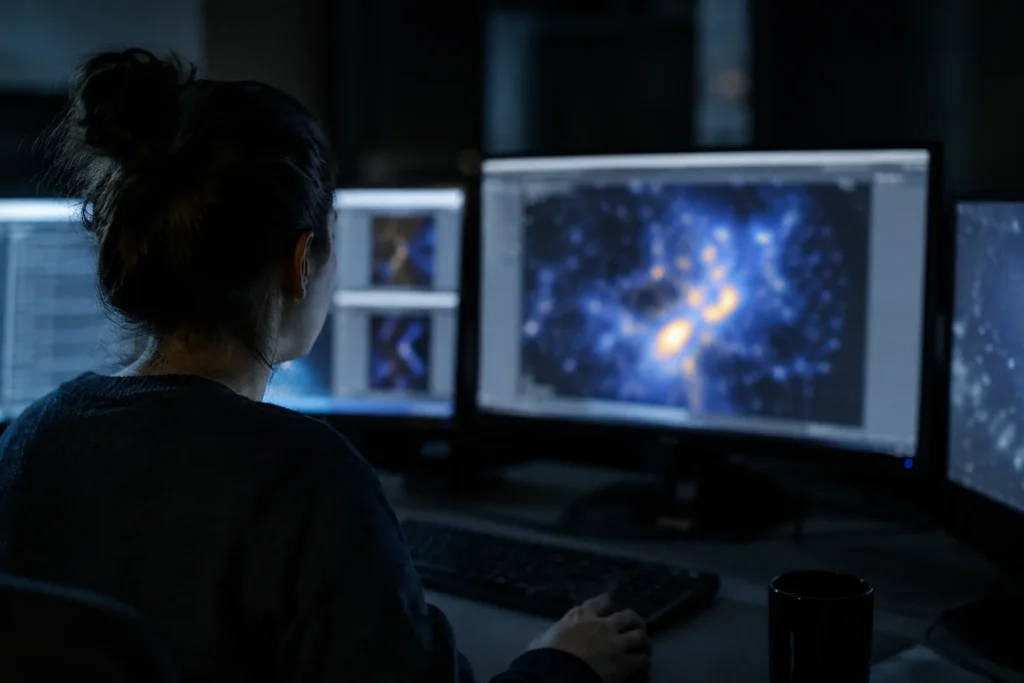
A scientific simulation and its finished picture are connected, but they are not interchangeable. The simulation calculates behaviour under physical assumptions. Visualisation turns those calculations into something people can inspect and understand.
What dark matter models can test
NASA explains that simulations can compare the consequences of different particle speeds. Cold dark matter means slow-moving dark matter in this context. Such models allow structures resembling observed galaxies to form and persist.
Here, “cold” describes the motion assumed for the dark matter. It is not a description of the black colour chosen for the featured image. The physical assumption belongs to the calculation; the colour belongs to its presentation.
The important comparison is between the structures produced by a calculation and those found through astronomy. Dark matter models become useful when their consequences can be set beside observations, rather than judged only by how convincing their images look.
That agreement has limits. A model that produces galaxy-like structures does not identify a particular particle. Nor does agreement establish that every assumption used in the calculation is correct. The model addresses how matter might behave, while its physical identity remains a separate question.
Turning calculations into a dark matter visualisation
The American Museum of Natural History’s Dark Universe educator guide describes a production that combines millions of astronomical observations with physics-based numerical models. Powerful computers calculate simulated cosmic phenomena, while scientists, artists and educators collaborate on their presentation.
This involves several different kinds of work. Observations provide information about the universe. Numerical models calculate behaviour using physics. Presentation choices determine how the resulting information appears to an audience. Keeping those roles separate helps explain what a scientific image can establish.
The guide’s Milky Way sequence offers a specific example. Scientists used supercomputer models, while artists assigned colours and brightnesses. Pink represented young star-forming regions. The presentation also draws heavily on the museum’s three-dimensional Digital Universe atlas.
That example shows why colour needs context. A colour can communicate a physical category or make a structure easier to follow without being a colour recorded by a telescope. The guide describes the museum production; it does not establish the exact process used for the featured APOD frame.
The black filaments and orange concentrations in NASA’s feature should be understood as explained visual conventions. A dark matter visualisation can communicate calculated relationships without being a direct view of the substance itself.
Methods behind a dark matter simulation
Research on visualisation also concerns how numerical information is represented. Ralf Kaehler, Oliver Hahn and Tom Abel’s A Novel Approach to Visualizing Dark Matter Simulations describes a method using phase-space information and a tetrahedral mesh.
Phase space describes positions and motions together. In the method outlined by the paper’s abstract, the mesh’s vertices follow simulated dark-matter particle positions. A tetrahedron is a shape with four triangular faces; a mesh connects such elements into a larger representation.
The particles in that description belong to the numerical simulation. Following their calculated positions is a method for representing the model, not a report that researchers have located individual dark-matter particles in space.
A related paper, Tracing the Dark Matter Sheet in Phase Space, is by Tom Abel, Oliver Hahn and Ralf Kaehler. Its abstract describes extracting information about dark-matter fluid flow from numerical simulations and possible improvements to modelling a collisionless fluid.
Both papers concern ways of working with simulated behaviour. Neither abstract reports the direct observation of a dark-matter particle. These methods provide context for understanding scientific visualisation, but they do not establish which method produced the particular APOD image.
The search for dark matter's physical identity
Scientists have not established what dark matter is made of. NASA discusses hypothetical candidates including weakly interacting massive particles, known as WIMPs, axions and primordial black holes. Dark matter could also have more than one constituent.
None of those possibilities becomes confirmed because a simulation produces a recognisable pattern of cosmic structure. The feature illustrates an explanation of how matter is arranged while leaving its underlying physical identity unresolved.
For further context, NASA’s dark-matter background page explains the observational evidence and candidate explanations. Read the featured picture alongside that evidence: as a tool for understanding a scientific model, not as a photograph of an identified substance.
Related reading
Questions about NASA’s dark-matter feature
What does NASA’s featured simulation show?
It represents simulated dark matter as black filaments and ordinary matter as orange concentrations. These are visual conventions, not the photographed colours of dark matter.
Is this a photograph of dark matter?
No. It is a computer-generated visualisation. Scientists investigate dark matter through its gravitational effects, rather than photographing light it emits.
Is NASA’s feature a new scientific discovery?
No. The 25 October 2026 feature is educational. NASA’s archive shows the same visualisation appeared on 20 October 2024.
What is dark matter?
Dark matter is matter inferred through gravitational effects that does not appear to absorb, reflect or emit light. Its physical identity remains unknown.
How is dark matter different from dark energy?
Dark matter contributes gravitational mass and helps hold galaxies together. Dark energy names the unknown cause of the universe’s accelerating expansion.
What observations support dark matter?
Galaxy motions within clusters, stellar motions within galaxies and gravitational-lensing measurements indicate gravitational mass beyond the observed ordinary matter.
How do simulations help scientists study dark matter?
Simulations calculate how modelled matter behaves under physical assumptions, allowing comparisons with observed cosmic structures. Visualisation makes those calculations interpretable without turning them into direct observations.
Do scientists know what dark matter is made of?
No. NASA discusses hypothetical candidates including weakly interacting massive particles, axions and primordial black holes. None is confirmed as the explanation, and dark matter could have more than one constituent.