
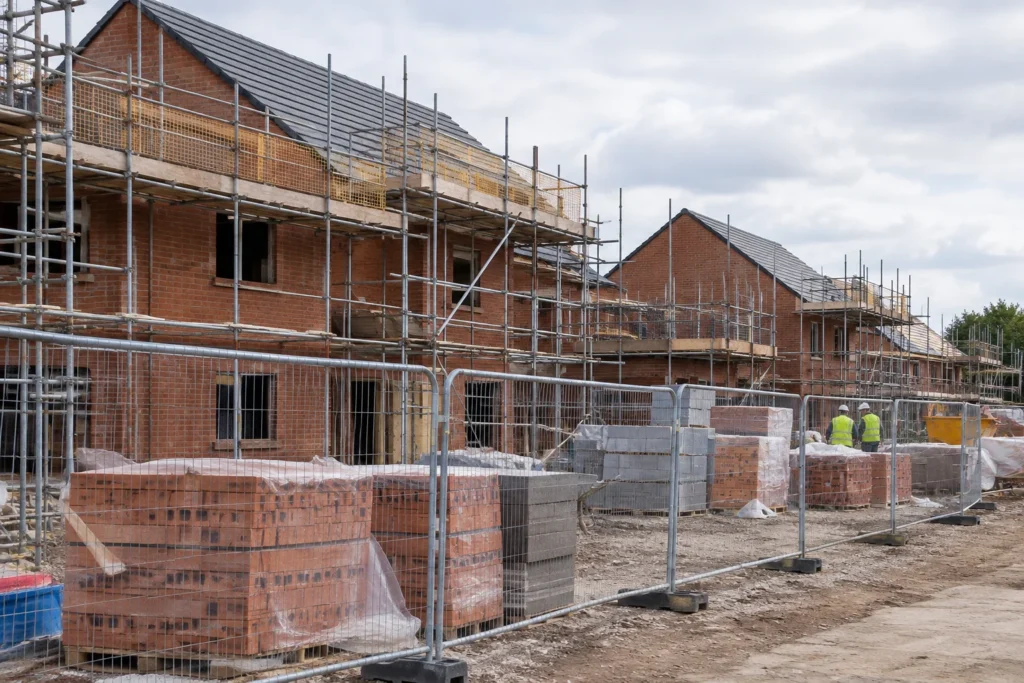
Rochdale Council reports £3.3 million in local spending, seven local employees and 95 weeks of training at John Rennie Place. The 81-home development has a December 2027 completion target.
Reported benefits before the homes are finished
John Rennie Place has supported local contracts, employment and construction training while its 81 homes remain under construction, according to Rochdale Council. Its 16 October 2026 update reports £3.3 million in local spending, seven local employees and 95 weeks of apprenticeship and T-Level training. The development, previously called Station Gardens, has a December 2027 completion target.
The figures describe benefits reported during construction, rather than completed housing. As at 24 October 2026, the latest dated council update distinguished money already spent from further contracts being finalised. The employment and training totals are council and contractor reports, not independently audited outcomes.
Local firms and community organisations benefit
The largest reported local contract contribution concerns Hovington Ltd. The council says the business, based less than a mile from the development, carried out all groundworks and received £3.3 million in project spending.
That gives the local spending figure a specific basis: work undertaken by an identified nearby company. It is not a calculation of the development’s wider economic impact, nor a measure of how much money subsequently circulated through Rochdale.
The council’s October community-benefits update also says contracts with two more Rochdale businesses were being finalised. Those agreements would take reported local spending to £5 million. The distinction matters: £3.3 million was reported as spent, while the higher total depended on further contracts.
Community support sits alongside those commercial arrangements. Springhill Hospice received £1,800, and the project team prepared and delivered hot meals for HMR Circle. These are separate forms of support, rather than additional construction contracts.
The update does not provide a recipient count for the meals or a monetary value for that activity. It therefore supports a specific account of what the team contributed, without establishing the overall reach or financial value of its community work.
Together, these details show how the council is reporting benefits before residents move into the houses. Procurement, charitable support and meals are distinct activities; none should be presented as evidence that the homes themselves have been delivered.

Jobs, placements and routes into construction
The council reports 95 weeks of apprenticeship and T-Level training supported by Willmott Dixon. That includes three T-Level placements for Hopwood Hall College students, linking the construction project with local technical education.
Training weeks measure an amount of activity. They do not mean 95 trainees, 95 qualifications or 95 permanent jobs. The three college placements are included in the reported training activity, so they should not be added to it as an equivalent measure.
The employment figure is different again. Seven local people were employed, including two who had previously been unemployed. The council’s work and skills team supported recruitment. The update does not establish that all seven roles are permanent or that further vacancies are currently available.
There is also an earlier commitment against which to understand the construction training report. In its November 2025 contract announcement, Willmott Dixon committed to 180 weeks of training across the project. The October 2026 figure records activity reported during delivery; the 180 weeks remains the original project-wide commitment.
The two figures should not be read as interchangeable outcomes. One describes training reported so far, while the other describes what the contractor said it would support over the project. Neither, on its own, establishes qualification completion or subsequent employment.
The original announcement also referred to engagement with Hopwood Hall College, Rochdale Sixth Form and Hollingworth High School. It included employment opportunities for long-term unemployed local people. Those statements describe the intended reach of the programme, rather than verified participant totals at each institution.
School engagement provides another route into construction careers. Willmott Dixon and Faber Joinery supported Newhouse Academy year 10 pupils towards the Baker Award. They also delivered a construction careers session for the school’s Young Leaders Programme. Support towards the award should not be confused with confirmation that pupils received it.
The contractor additionally reported delivering a Building Lives Academy programme for local people outside education, employment or training. This broadens the account beyond students already following a college course. However, the update supplies no participant total or subsequent job outcomes for that programme.
What John Rennie Place will deliver
John Rennie Place is the new name for the development previously known as Station Gardens. The council says it honours the Rochdale Canal engineer. Its first phase comprises 81 houses on previously vacant brownfield land near Drake Street and Rochdale railway station.
Rochdale Development Agency is delivering the scheme for Rochdale Borough Council, with Willmott Dixon as main contractor. These roles separate the council-backed development programme from the company undertaking the construction work.
The development agency’s 6 November 2025 announcement that construction was under way described two-, three- and four-bedroom houses. It also announced mixed tenures, including social and affordable homes. A final tenure breakdown, individual prices, rents and application arrangements are not established by those details.
The construction timetable has changed between announcements. Willmott Dixon initially expected completion in early 2028. A published extract from the portfolio report for the 17 December 2025 Council meeting referred to January 2028, following an early-November groundbreaking and an anticipated build lasting just over two years.
The council’s 16 October 2026 update gives the later-published target of December 2027. That is the latest completion forecast available for this account as at 24 October 2026. It supersedes the older expectations for reporting purposes, but remains a target rather than a completed milestone.
The council describes the houses as being built to a net-zero standard. The development agency had presented the project as delivering the council-supported development’s first net zero homes. These are statements about the intended housing standard, not measured performance from occupied properties.
No houses were reported completed in the October update, and no operational performance measurements were provided. The distinction is important when assessing progress: construction activity, a specified environmental standard and performance after occupation are different stages. John Rennie Place has reported progress and community benefits, but not completed-home results.
How the first phase reached construction
The development agency announced a successful £15 million bid to the government’s Community Regeneration Partnerships Fund. That provides funding context for the scheme, but it is not a verified statement of the entire construction cost or the main contract’s value.
The formal route into construction is recorded in the council’s main-contract delegated decision, signed on 17 October 2025. It followed Cabinet’s decision of 29 July 2025 and concerned Phase 1: the 81 houses then identified as Station Gardens.
The delegated decision approved agreement of the contract value and entry into a JCT Design and Build 2016 contract with Willmott Dixon. That is the contract form specified in the record. The approval should not be confused with a new announcement of completed work.
The document proposed signing the main contract on 23 October 2025, setting up the site on 27 October and beginning main works in early November. These were the decision record’s planned dates. The subsequent development agency announcement provides separate evidence that construction was under way by 6 November.
The record explains why starting mattered. Its rationale included beginning delivery, addressing the planning timetable and demonstrating delivery to the Ministry of Housing, Communities and Local Government. The proposed sequence linked the contractual decision with the practical start on site.
It also set out the assessed consequences of not proceeding. According to the decision record, failure to start would require a new planning application and put government funding at risk, because spending had to be committed by March 2026.
The document anticipated a fresh tender, likely higher costs and another Cabinet approval in that scenario. Those were risks considered when approving the contract route, not a report that funding was lost or a replacement tender actually occurred.
This chronology explains the move from approval to construction without treating every proposed date as independently confirmed. It also keeps the funding announcement separate from the contractual arrangements used to deliver the houses.
The station gateway and the next decisions
John Rennie Place forms part of a wider station-area regeneration picture. Willmott Dixon’s November 2025 announcement placed it within the council’s rail corridor strategy, intended to support new homes on brownfield land around Rochdale’s five railway stations. That is a strategic intention, not a measurement of regeneration already achieved.
The neighbouring proposal for 142 apartments is separate from the 81 houses. In October 2026, the council expected procurement of a delivery partner to begin soon. That statement does not establish that apartment construction had started, and the apartments cannot be added to a completed housing total.
There are other station-area references to keep distinct. The contractor’s November 2025 announcement mentioned a new public square in front of Rochdale station and 33 proposed apartments at Maclure Road and Station Road. Its expectation of an early-2026 apartment start was historical; it is not confirmation that work subsequently began.
Further council business was also pending at the 24 October 2026 cut-off. The forward plan scheduled a John Rennie Place marketing-strategy decision for 27 October, previously listed for 25 August. The 27 October Cabinet agenda included the scheme as item 9, after proposed exclusion of the press and public, with a report from the Director of Economy and Place.
A scheduled item is not an approved decision, and it does not establish unpublished sales or application arrangements. For readers following the scheme, the next useful step is to check subsequent council decisions and progress updates. The present distinction remains clear: reported local benefits during construction, houses targeted for December 2027, and neighbouring proposals still awaiting progression.
Questions about John Rennie Place
How much local spending has John Rennie Place generated?
Rochdale Council reported £3.3 million spent with Hovington Ltd in its 16 October 2026 update. Contracts being finalised with two further Rochdale businesses would bring the total to £5 million; that higher figure was conditional.
Which community organisations received support?
The council’s 16 October 2026 update reported £1,800 for Springhill Hospice. The project team also prepared and delivered hot meals for HMR Circle.
How much construction training has the project supported?
The council reported 95 weeks of apprenticeship and T-Level training, including three Hopwood Hall College T-Level placements, on 16 October 2026. Willmott Dixon’s original project-wide commitment was 180 weeks. Training weeks are not a count of participants or qualifications.
How many local people have been employed?
Seven local people had been employed, including two who were previously unemployed, according to the council’s 16 October 2026 update. Its work and skills team supported recruitment.
What is John Rennie Place?
John Rennie Place is an 81-house development near Rochdale railway station, previously called Station Gardens. The development agency announced two-, three- and four-bedroom houses with mixed tenures, including social and affordable homes.
When are the homes expected to be completed?
The council’s 16 October 2026 update targets December 2027. This remains a forecast, and no houses were reported completed in that update.
What government funding was announced?
Rochdale Development Agency announced a successful £15 million bid to the government’s Community Regeneration Partnerships Fund in November 2025. This funding figure should not be treated as the development’s total construction cost.
Are the neighbouring 142 apartments part of a completed housing total?
No. The 142 apartments are a separate proposal, with delivery-partner procurement anticipated in the October 2026 council update. Neither those apartments nor the 81 houses were reported completed.