
LanthaGen Bio’s £100,000 equity award will support research into an unnamed metal and extend scientists’ contracts, according to the University of Manchester.
New backing for metal recovery research
Manchester start-up LanthaGen has won a £100,000 equity investment to support new metal recovery research and extend scientists’ contracts. The University of Manchester announced LanthaGen Bio’s success in the inaugural Coller AI Competition on 16 October 2026, following a final involving five shortlisted ventures.
The award backs a business combining computational protein design with laboratory experiments. Its immediate significance is research capacity: investigating an additional metal and retaining scientific expertise in Greater Manchester. The account below reflects announcements available by 23 October 2026.
Manchester start-up LanthaGen secures Coller AI investment
The competition was established by the University of Manchester and the Jeremy Coller Foundation for early-stage ventures applying artificial intelligence to global challenges. Responsible development and benefits for people and society were central to its stated purpose.
The university’s original competition timetable opened applications on 14 July 2026 and set a closing date of 1 September. Finalists were due to be notified on 21 September, with final pitches and the award scheduled for 9 October. Eligibility required at least one founder to be a university student, staff member or alumnus.
Those dates distinguish the planned competition event from the later reporting. The university published its first account of the result on 12 October, followed by a more detailed announcement on 16 October.
The 12 October account of the final places it in the Nancy Rothwell Building. Dan Healy, LanthaGen Bio’s chief technology officer and co-founder, led the pitch. He accepted the award alongside chief scientific officer Ellie Goulding, with Jeremy Coller Foundation Investment Principal Harry Kalms presenting it.
The £100,000 is equity investment, not a research grant. That distinction separates it from the company’s previously reported grant funding. The announcements do not establish an ownership percentage, company valuation, investment completion date or detailed conditions.
Funding a new metal project and researcher contracts
In the university’s 16 October announcement, Healy said the investment unlocked research into a new metal that the company had previously been unable to investigate. The metal was not named.
The same report said the funding would allow extensions to the contracts of the company’s PhD scientists in Greater Manchester. It reported a six-person team and £2.4 million in grant funding already secured.
These figures describe the business at the time of the announcement. Contract extensions concern continuity for researchers; the report does not specify additional recruitment, individual contract lengths or a new employment total.
How AI protein design connects with laboratory testing
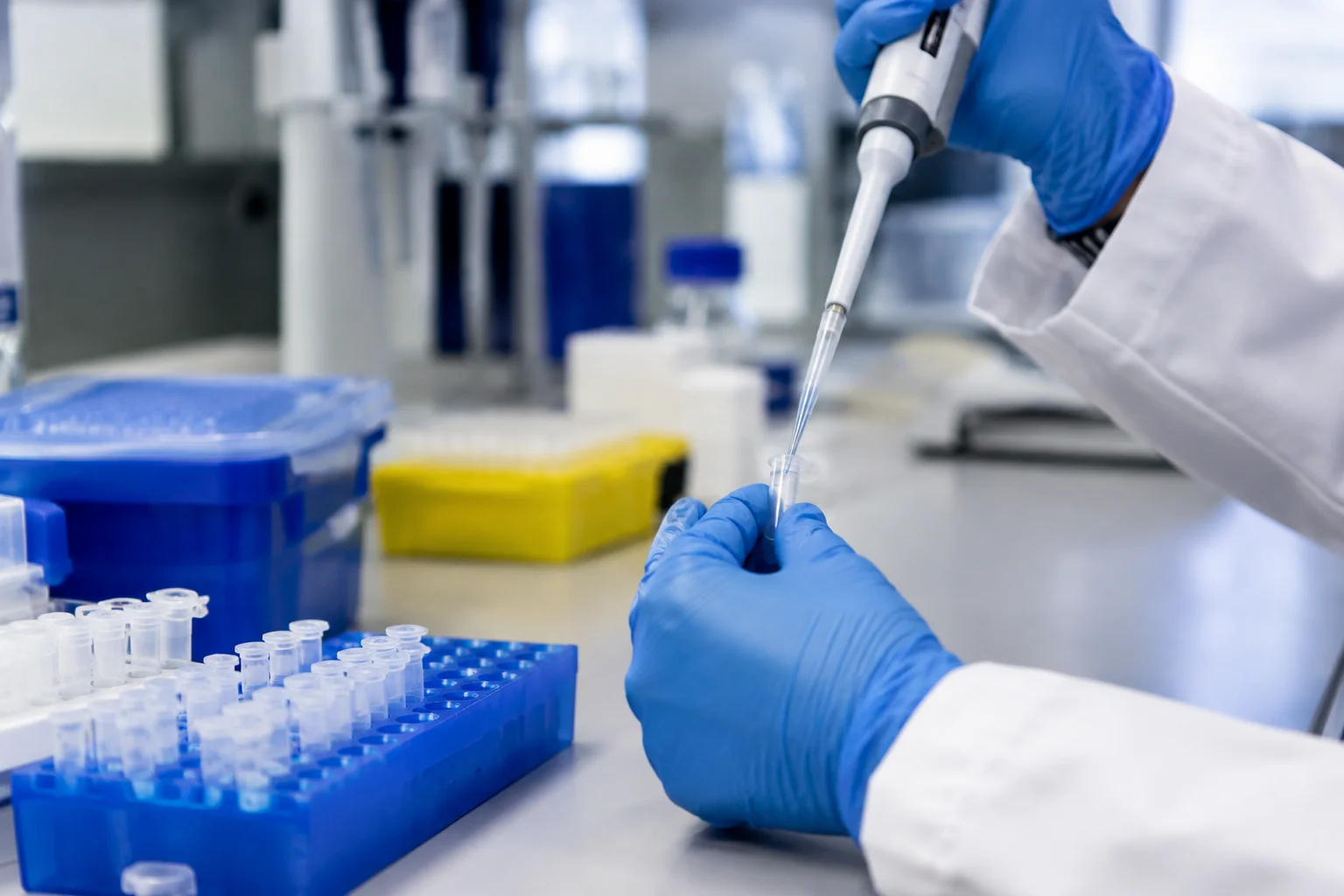
LanthaGen Bio describes a development process that moves between computer-based discovery and physical experiments. AI helps identify promising biological candidates, but laboratory work remains part of checking whether those candidates behave as predicted.
In the computational discovery stage, the company says it uses computational chemistry and machine learning to explore protein sequences. A protein sequence is the ordered chain of building blocks that helps determine a protein’s structure and behaviour. The aim is to find candidates with the potential to bind valuable metals selectively.
Its description of the protein-design workflow then sets out a refinement stage. Promising candidates are developed further for their binding properties and suitability for experimental testing. An initial computational result is therefore a starting point, rather than a finished recovery technology.
Laboratory validation follows. Candidate proteins are produced and tested experimentally to investigate their performance and check the computational predictions. This gives the team evidence about the behaviour of the actual biological material, rather than relying entirely on a model.
The results feed back into discovery and optimisation. Successive cycles allow candidates to be reconsidered and refined as experimental evidence becomes available. Computation proposes possibilities; testing supplies information for the next round.
This connection explains why the award concerns both AI and research staff. The company’s stated method depends on computational design and scientists conducting experiments. Its eventual goal is practical recovery of critical materials, but the workflow itself does not establish commercial throughput, operating costs or environmental savings.
Recovering target metals from complex waste
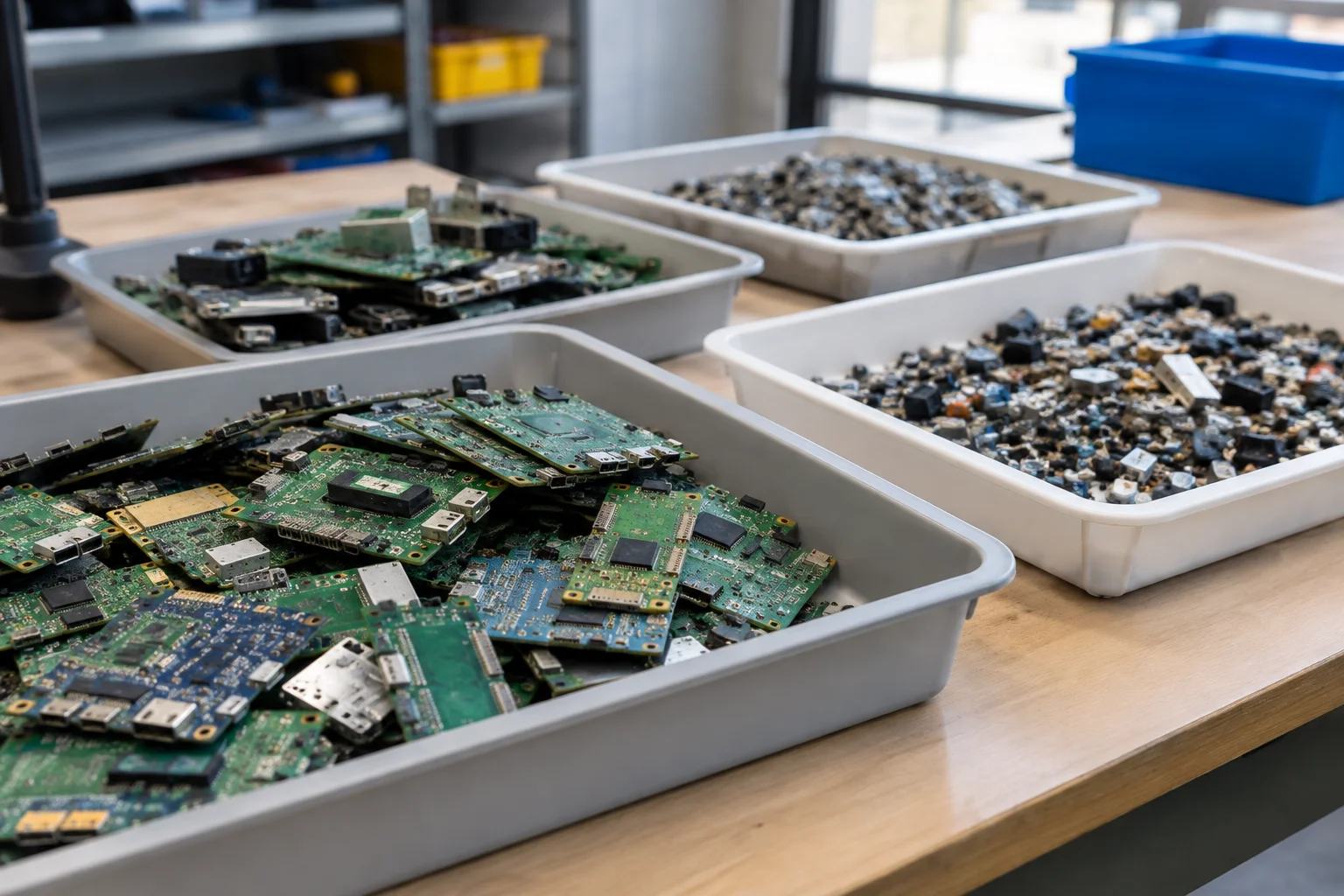
The company calls its platform Biomagnets. In a founder interview published by ELEMENTAL on 20 May 2026, it described biomolecules that bind target metals in solution while allowing unwanted impurities to pass through.
The central idea is selectivity: capturing a chosen metal rather than collecting everything in a mixture. That matters to the proposed application because waste streams can contain several materials that need different treatment.
The interview identified electronic waste and mining tailings as target applications, with an initial focus on lanthanides, a group of rare earth elements. It also discussed exploration of gold, platinum, palladium and cobalt. None of those historical examples identifies the unnamed metal supported by the October award.
In their May interview with Sister, the founders envisaged selective biological capture working alongside conventional chemical processes. Their proposal was complementary: different methods could contribute different parts of the recovery process.
Both interviews describe the company’s approach and intended applications. They provide context for LanthaGen Bio’s research, not evidence that these waste streams are already being processed commercially at scale.
From university project to early financial backing
The founders traced the business to an informal University of Manchester synthetic-biology project investigating rare earth recovery from UK waste. In Sister’s 20 May founder interview, they said open-access computational chemistry software and data helped them engineer biomolecules for selective capture.
An earlier funding milestone came through the university’s Ideas with Impact awards. Its report names Dan Healy of LanthaGen Bio as a £75,000 winner following the pitching event on 14 July 2025.
That entry concerned engineered bacteria extracting metals from complex mixtures associated with mining waste or electronics recycling. It records an earlier description of the venture’s approach, distinct from the more detailed protein-design workflow now presented on its website.
The founders subsequently told Sister that the philanthropic support enabled experimental validation with external UK collaborators. They said this helped them secure approximately £1.1 million in non-dilutive funding from Germany’s SPRIND agency and supported early computational and team activity.
The Ideas with Impact report also documents support beyond money. The programme received 146 applications and brought 14 finalists to pitch. Winners received access to mentors, networking and guidance on developing research and intellectual property into ventures.
The earlier £75,000 and approximately £1.1 million are historical milestones. They may already be included in October’s £2.4 million grant total and should not be added to it again.
The wider SPRIND metal recovery challenge
SPRIND’s Tech Metal Transformation Challenge provides wider context for this research area. The programme runs over three years and three stages. Eight teams were selected for its first stage in December 2025.
Its technical task extends beyond isolating individual metals. Teams are asked to develop a functional, end-to-end prototype that processes metals from at least two substantially different end-of-life products into functional metal. The goal is material that can be reused, rather than separation as an endpoint.
The programme invites modular combinations of biological, chemical and physical-mechanical methods. Its examples of complex waste streams include electronics, batteries and electronic components.
That scope helps explain the interest in selective techniques that can form part of a larger recovery process. SPRIND explores alternatives to relying solely on high-temperature melting or non-selective leaching, where chemicals draw materials out of a mixture without the same targeting.
Reduced energy and chemical requirements are programme development goals. They are not measured environmental results for LanthaGen Bio.
The published funding ceilings are also programme limits, not the company’s receipts. They are €1.5 million per team for stage one, €2 million for stage two and €2.5 million for stage three, plus VAT. Progression depends on evaluation, so later-stage funding cannot be treated as guaranteed. These maxima should remain separate from the historical sterling amount reported by the founders.
Manchester foundations and the development pathway
The local connections go beyond the competition. Sister’s May profile located LanthaGen Bio at the Renold Innovation Hub. The founders said they carried out computational work and meetings at Sister and had two active projects with University of Manchester principal investigators, giving access to academic expertise and instrumentation.
Those are dated accounts of workspace and collaboration, rather than confirmation that every arrangement remained unchanged in October. The May ELEMENTAL interview identified the co-founders as Dr Sahara Bhanot, chief executive; Dan Healy, chief technology officer; and Dr Ellie Goulding, chief scientific officer.
In that interview, the company’s priorities included validation in relevant operating environments, dedicated laboratory capacity, team development and a broader Biomagnets portfolio. Commercial prototype testing, partnerships and pre-seed investment were described as steps towards future pilot-scale development, not completed milestones.
Sources
- University of Manchester start-up LanthaGen Bio wins £100,000 Coller AI Competition to fund new research
- Five ventures, one winner: Coller AI Competition awards £100k
- www.manchester.ac.uk
- LanthaGenBio
- Member Spotlight: LanthaGen Bio – ELEMENTAL
- LanthaGen Bio: A Greener Way to Capture Rare Earth Elements
- Donor-funded Ideas with Impact Awards support budding founders at The University of Manchester
- SPRIND | Tech Metal Transformation Challenge