
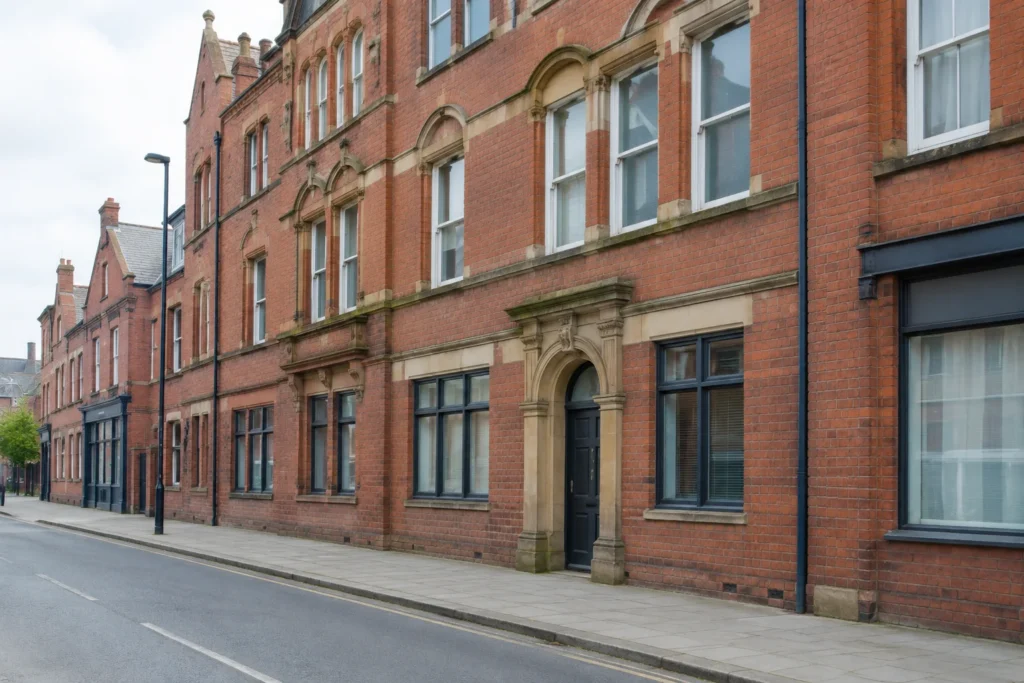
Oldham Council has secured £1 million to protect the Grade II-listed Prudential building on Union Street. The funding supports essential preservation while longer-term plans remain under development.
Protection funding secured, future use unresolved
Oldham Council has secured £1 million for essential works to protect and preserve the Grade II-listed Prudential building, while longer-term plans remain under development. Announced on 15 October 2026, the grant does not establish a reopening date or final use for the Union Street landmark.
The award comes from the Heritage at Risk Capital Fund, delivered by Historic England with government funding. As at 23 October 2026, the announcement sets out a safeguarding purpose rather than a confirmed programme for full restoration and occupation.
What the £1 million Prudential building award will support
The council’s funding announcement describes essential protection and preservation for the historic property on Union Street, beside Oldham Central Metrolink stop. It places the immediate intervention alongside continuing work on the building’s longer-term future.
Council Director of Growth James Kington described the need for essential protection while longer-term opportunities continue to be explored. Historic England’s Louise Brennan presented the programme as support for urgent conservation and sustainable futures.
Waterhouse’s architecture and the building’s changing uses
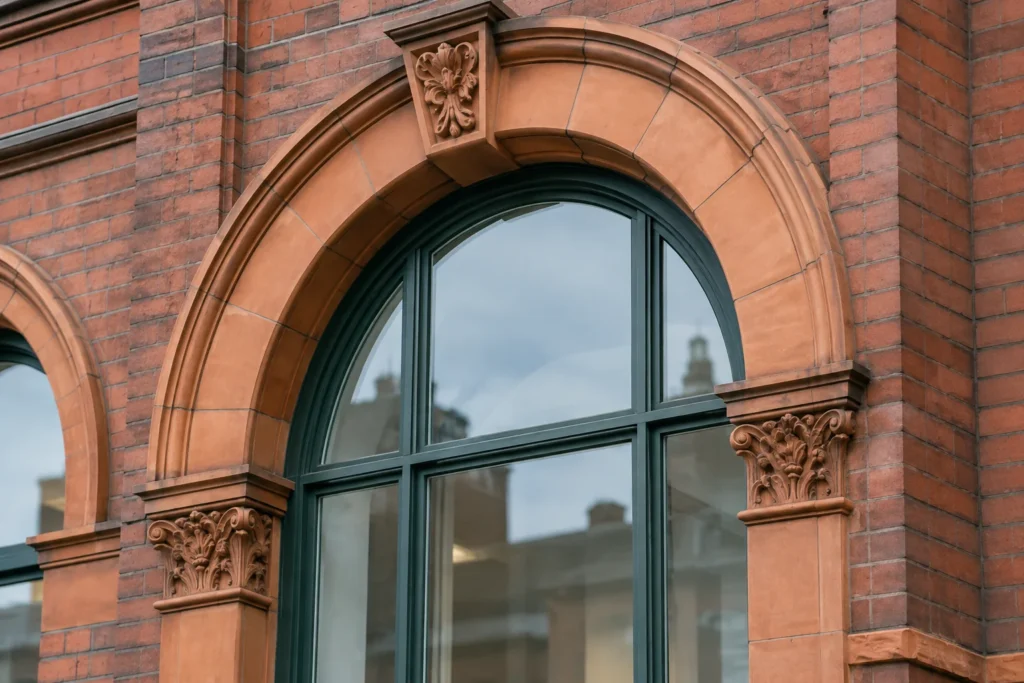
Historic England’s statutory listing dates the Prudential building to 1889 and identifies Alfred Waterhouse as its architect. It was listed at Grade II on 23 January 1973, under entry number 1282574.
The description records brick construction with terracotta dressings and a red plain-tiled roof. Three storeys stand above a basement, with an attic above. Recessed polygonal towers flank the three-window frontage, giving the elevation its distinctive form.
At street level, the recorded entrance includes a polished granite base and piers, a round-arched doorway and a shallow projecting porch with a gable. Three broad round-arched windows occupy the ground floor, with raised Prudential Assurance Buildings lettering above.
The upper windows contain vertical and horizontal divisions, known as mullions and transoms. Decorative terracotta surrounds and ornamental panels add detail. The listing also records a lozenge-patterned band and a projecting decorative cornice below the roofline, with interlaced decoration on the towers.
The design extends beyond the principal frontage. Historic England records white glazed brick on the west-facing side and a rear range linking the wings. Inside, the main hall’s documented features include an ornate plaster-panelled ceiling and tiled walls.
The Victorian Society’s historical assessment of the former offices places them within Prudential’s nineteenth-century commissioning in prosperous industrial cities. It identifies Classical, Gothic and Byzantine influences, describing a coordinated design extending from the exterior to cabinetry and interior finishes.
Its account explains how red brick, terracotta, timber and ceramic tiles contributed to an interior intended to impress customers. These are documented architectural assessments, not findings from a new condition inspection.
The property also had uses beyond insurance offices. The council’s Time Trek Trail records Café Monico in the basement, describing its past role as a nightclub. That history gives the Union Street landmark a social dimension alongside its commercial and architectural significance.
From deterioration to council ownership
Concerns about the Prudential building predate the latest grant by several years. The Victorian Society urged conservation-led reuse and called for the council to consider enforcement or compulsory purchase if necessary.
The council’s 2019 conservation appraisal recorded 79 Union Street as vacant and in poor condition, with the tower roofs already lost. It praised the elaborate terracotta and granite, strong architectural form and conspicuous rear elevation, while identifying deterioration as harmful to the conservation area.
On 28 February 2022, a Cabinet record described proposals for a repairs notice under section 48 of the Planning (Listed Buildings and Conservation Areas) Act 1990. This was to be followed by compulsory purchase under section 47, with preservation and halting deterioration as the objectives.
The March 2023 planning report subsequently recorded Historic England’s assessment that prolonged disuse, poor maintenance and failed roof coverings had caused widespread water ingress. That account describes conditions assessed for the earlier planning process, rather than an October 2026 survey.
The council announced acquisition through compulsory purchase on 25 October 2024. Its stated immediate priority was to make the Prudential building safe before restoration.
A portfolio report prepared for 18 December 2024 placed the ownership transfer in mid-October. It also reported that an initial asbestos survey was being undertaken to establish safe methods for an environmental clean-up.
The earlier workspace plans and conservation proposals
The Prudential building has previously featured in proposals for business accommodation. The 2022 Cabinet discussion concerned an incubation hub within the Future High Streets Fund programme, rather than the Heritage at Risk award announced in October 2026.
That earlier discussion followed confirmation of Future High Streets Fund support in June 2021. The proposed conversion sought additional office accommodation for digital, creative and media businesses within the council’s Creating a Better Place framework.
The November 2024 town-centre framework places the property in the south-western corner of the Cultural and Creative Quarter, opposite Oldham Central Metrolink stop. It records the building as vacant since 2011.
The framework states that planning permission and listed building consent were obtained in July 2023 for repair and redevelopment. The scheme included co-working space, a café, meeting space and offices over five floors, under references FUL/351029/23 and LBC/351030/23.
A separate report considered by the Planning Committee on 8 March 2023 illustrates the conservation issues involved in workspace conversion. Proposals included dormer windows, contemporary lanterns above the turrets and a glazed roof enclosing the central atrium.
For the principal hall, proposed work included tile repairs, restoration of plaster ceilings and parquet flooring, and removal of later partitions. Historic timber screens, glazing and counters were to be repaired and incorporated into a café or lounge. Officers sought supporting surveys, methods, samples and specifications.
These details explain the earlier approach to adapting historic interiors. They are not the specification for the newly funded Prudential building works.
Following compulsory purchase, the November 2024 framework prioritised safeguarding and weatherproofing before wider options were explored. The business-space history is relevant local context, but the new grant does not confirm tenants, jobs or delivery of that earlier scheme.
How the Heritage at Risk Capital Fund works
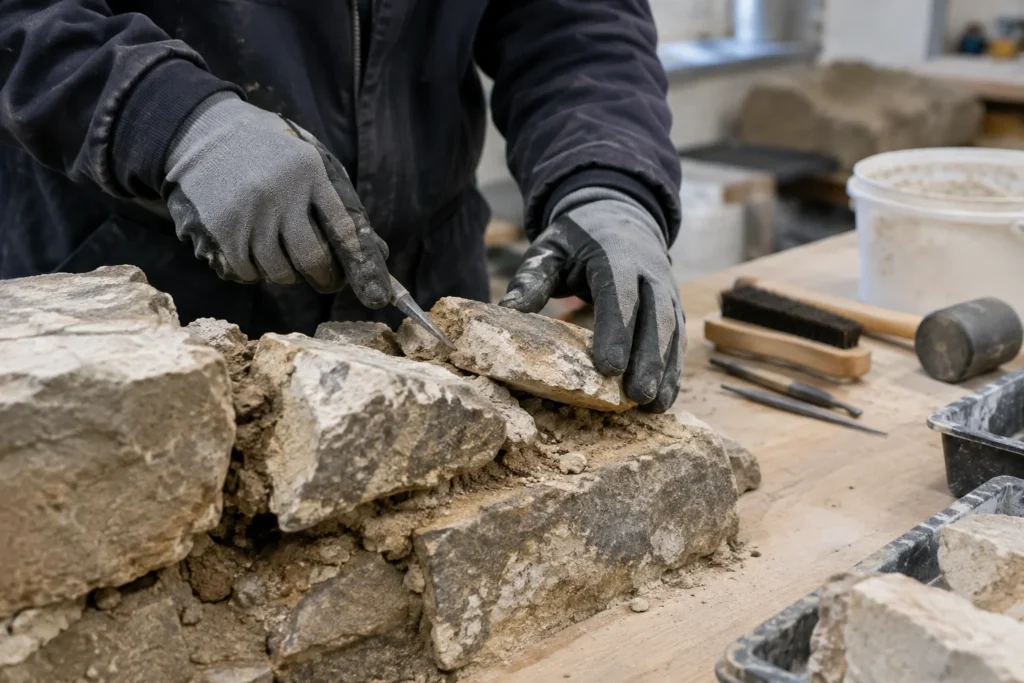
Historic England’s fund guidance describes a programme intended to safeguard heritage, reduce deterioration and support safe, productive use. It also targets disadvantaged communities, with competitive applications assessed against investment need and community benefit.
The guidance records £15 million invested in the first year and up to £60 million remaining for allocation over the following four years to 2030. Grants of up to £1 million are available to applicants legally responsible for an eligible asset.
Eligible activities include capital repair and preservation, associated preparatory investigations and temporary protection for vacant buildings. Examples include urgent repairs, security measures, fire prevention and vegetation control.
Those examples describe the fund’s scope. They do not establish which individual measures will be carried out at the Prudential building, because the council’s award announcement does not provide that level of detail.
The guidance also allows qualifying adaptive reuse and accessibility works. Standalone project-development work is excluded. This distinction separates physical conservation and associated preparation from development work undertaken on its own.
Eligible assets include Grade II-listed buildings within conservation areas. Publicly owned sites must not form part of the public body’s operational estate, and applicants must have legal responsibility for the property.
Oldham’s award within the national heritage announcement
The government announcement of 15 October 2026 named the Prudential building among 20 Heritage at Risk Capital Fund recipients sharing nearly £13 million. Oldham’s individual award is £1 million; the wider programme is worth £75 million.
Other named recipients include Gorton Monastery in Manchester, Prescot Picture Palace, Shildon Railway Institute and Blackpool’s former Abingdon Street Post Office. These are separate projects, not components of Oldham’s allocation.
For Oldham, the significance is specific: funding has been secured to protect a historic property after years of documented deterioration and the council’s compulsory purchase.
Sources
- £1 million awarded for essential works at historic Prudential building | Oldham Council
- Prudential Assurance Buildings, Non Civil Parish – 1282574 | Historic England
- www.victoriansociety.org.uk
- www.oldham.gov.uk
- www.oldham.gov.uk
- committees.oldham.gov.uk
- www.oldham.gov.uk
- committees.oldham.gov.uk
- committees.oldham.gov.uk
- committees.oldham.gov.uk
- Heritage at Risk Capital Fund | Historic England
- Major drive to restore churches and revitalise heritage buildings in communities across England announced – GOV.UK
- www.victoriansociety.org.uk