

Ministers visited Manchester’s Sister innovation district on 23 October 2026, meeting businesses and researchers at Renold Innovation Hub and Concretene. The University’s report highlights existing partnerships alongside longer-term regeneration ambitions.
A closer look at Manchester’s research-to-business links
Ministers visited Manchester’s Sister innovation district on Friday, 23 October 2026, meeting businesses at Renold Innovation Hub and Concretene’s founders in the Pariser Building. The University of Manchester’s account describes a visit focused on links between university research, enterprise and civic partners, rather than a confirmed funding announcement.
The visit brought together businesses working in offshore forecasting, metal recovery, genetic screening, supplements and construction materials. It also highlighted the distinction between activity already taking place at Sister and the district’s much larger regeneration ambitions.
What happened during the ministerial visit
According to the University’s account of the ministerial visit, Jonathan Reynolds and Small Business Minister Lord Leong visited Renold Innovation Hub on 23 October. The report was published at 14:50 that day, London time.
Their hosts included Professor Duncan Ivison, the University’s President and Vice-Chancellor, and Professor Aline Miller, Associate Vice-President for Enterprise. Liz Bamber, Sister Director of Place, also took part. Discussions concerned collaboration between the University, businesses and civic partners.
Reynolds’s government biography records his appointment as Secretary of State for Business, Innovation, Science and Trade on 20 July 2026. He had previously served as Chief Whip. That appointment predates the October visit and provides the ministerial context for his attendance.
Sister innovation district and the policy context
The University placed the visit ahead of an SME conference in Manchester and a forthcoming government Budget. Its account described small-business support as expected, not as a package already announced.
That distinction matters when assessing what the visit established. The report documents meetings and discussions, but does not establish a confirmed Budget allocation to Sister. Nor does the visit itself demonstrate that participating businesses secured new contracts or investment.
The substantive local story is therefore the research and business activity ministers encountered, alongside the facilities and partnerships intended to support it.
The businesses connecting research with commercial ideas
The University names four businesses ministers met at Renold. NeuWave Technologies combines artificial intelligence and ocean science for offshore predictions. LanthaGen Bio is developing binders for metal recovery.
MolMart offers preconception genetic screening, while Brain Feed Therapeutics is a cognitive-supplement business. These descriptions identify their activities; they do not establish clinical effectiveness, regulatory approval or suitability for an individual.
Together, the businesses illustrate the range of commercial ideas represented during the visit. Their work spans digital prediction, materials recovery and health-related products and services, rather than a single technology or market.
The University’s account establishes that the meetings took place and describes the businesses involved. It does not provide a common measure of their commercial maturity, performance or growth. The examples are therefore evidence of the range of activity presented to ministers, not equivalent measures of business success.
Concretene and the route from laboratory to construction
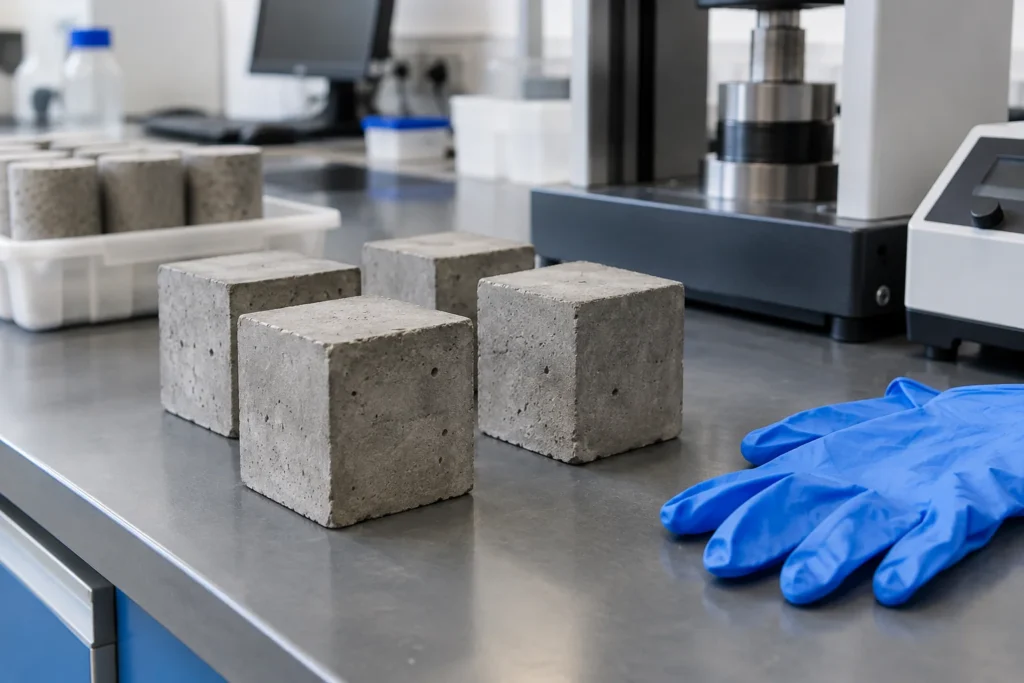
Ministers also met Concretene’s founders in the Pariser Building. The University attributes its development to work involving the Graphene Engineering Innovation Centre, known as GEIC, its engineering department and Nationwide Engineering.
The University reports an 18-month journey from laboratory work to a commercial product. That is its account of the development process, rather than an independently established timetable for every subsequent stage of the business.
Research commercialisation through concrete demonstrators
Concretene’s product and company history describes a graphene-based admixture tailored for concrete, mortar and grout. An admixture is an ingredient added to alter a mixture’s properties.
The company says improved performance can allow less cement to be used while maintaining design strength. It presents reduced embodied carbon as a consequence of lower cement content and claims cost neutrality at scale. Those claims should not be read as demonstrated outcomes for every application.
Its own chronology dates initial University research to 2019, followed by a £378,000 Innovate UK-supported development phase in 2020. The company identifies three demonstrators in 2021: a gym floor in Amesbury, a parking bay outside GEIC and a mezzanine deck at Manchester’s Escape to Freight Island.
According to Concretene, those projects together involved more than 300 cubic metres of graphene-enhanced concrete. Its account then records £3.5 million in LocalGlobe seed funding in October 2022, followed by Manchester laboratory and testing facilities.
These dated milestones provide a broader company history alongside the University’s reported 18-month development period. They should not be compressed into a single claim that all research, demonstrations, funding and facilities appeared within that period.
For the Sister innovation district, Concretene offers a specific example of research commercialisation: university-linked materials work progressing towards construction applications. The visit highlighted that history; it did not itself verify the company’s environmental or cost claims.
What Renold Innovation Hub offers businesses

Renold Innovation Hub occupies a modernised former teaching building. Published descriptions checked on 25 October 2026 present it as workspace for early-stage and scaling businesses, combined with meeting facilities and a support environment.
The University’s Innovation Academy description of Renold lists hot desks, co-working and private office suites. It also identifies internet connectivity, breakout areas, meeting rooms and an on-site café.
The advertised offer extends beyond desks. It includes training, mentorship, investment expertise, funding opportunities and opportunities to collaborate. These are descriptions of available forms of support, not evidence that every occupier receives investment or achieves growth.
The University describes co-working pricing as tiered according to a business’s growth stage. It does not provide a basis here for quoting a particular business’s costs or determining which tier would apply.
Sister’s Renold workspace page also describes flexible co-working desks and private serviced offices. Its event facilities include a large auditorium, breakout areas and flexible social spaces for talks, workshops and conferences.
The distinction between workspace and event provision helps explain the hub’s role. Renold is presented both as somewhere businesses can work and as a venue for bringing people together. Current space availability, booking arrangements and exact prices would need to be confirmed directly rather than inferred from those published descriptions.
The specialist support behind the workspace
The Renold brochure identifies four specialisms: digital technology, health innovation, biotechnology, and advanced materials and manufacturing. Its programme descriptions explain the research and business networks associated with the workspace.
Turing Innovation Catalyst Manchester’s listed programme areas include venture building, accelerators, investment readiness, skills and collaborative research. These cover different parts of developing an enterprise, rather than simply providing office accommodation.
The brochure presents the Christabel Pankhurst Institute as a partnership involving the University, the NHS, businesses and local government. Its stated purpose is to translate research into health and care products and services.
For biotechnology, the Industrial Biotechnology Innovation Catalyst is described as a collaboration between North West universities and industry. Its advertised offer includes research facilities, accelerator programmes, skills development and business advice.
GEIC is described as an industry-led centre on the wider Sister site. It works with companies to develop and scale applications of graphene and other two-dimensional materials. This provides context for the materials-development activity highlighted through Concretene.
The brochure also describes tailored training, mentoring, access to investors and funders, and community engagement. These are elements of the support environment, not evidence that participants have already secured finance or achieved commercial growth.
The brochure’s publication date is not established. Its descriptions explain the programme model, but should not be used as confirmation of current openings, application deadlines or tenant numbers. For businesses, the relevant distinction is between the advertised support framework and the terms of a particular opportunity.
How Sister fits Manchester’s longer-term regeneration
The University identifies Sister as the transformation of its former North Campus in partnership with Bruntwood SciTech. It describes Renold as the first step towards a district intended to bring spin-outs, start-ups and research collaborators together with multinational businesses.
Sister’s published district ambitions, checked on 25 October 2026, cover four million square feet overall. They include more than two million square feet of workspace, more than 1,500 homes and more than 10,000 new jobs.
Those figures describe the planned district, not completed delivery. Its proposed mix also includes offices, leisure and community uses, green spaces, a civic square, shops, cafés, restaurants and bars.
The distinction between existing facilities and future development is central to understanding the Sister innovation district. Renold’s published workspace offer and the businesses ministers met are different kinds of evidence from projected homes, employment and floorspace.
The October visit brought attention to reported university–business connections already taking shape. It did not, by itself, establish new jobs, construction progress or delivery of the wider plans.
Readers following the project can use the University’s visit report for the account of the meetings and Sister’s district information for its development ambitions, keeping those two parts of the story separate.
Related reading
Frequently asked questions
When did ministers visit Sister?
The University of Manchester reports that Jonathan Reynolds and Small Business Minister Lord Leong visited on Friday, 23 October 2026. Its account was published that day.
Did the visit announce Budget funding for Sister?
The University’s report described expected small-business support ahead of a forthcoming Budget. It did not establish a confirmed Budget allocation to Sister.
Which businesses did ministers meet at Renold?
The University names NeuWave Technologies, LanthaGen Bio, MolMart and Brain Feed Therapeutics. Ministers also met Concretene’s founders in the Pariser Building.
What is Concretene?
The company describes Concretene as a graphene-based admixture for concrete, mortar and grout, intended to improve performance and potentially reduce cement requirements. These are company claims, not guarantees for every application.
What workspace does Renold Innovation Hub provide?
Published descriptions checked on 25 October 2026 include hot desks, co-working and private offices, alongside meeting and event facilities. They do not establish current availability or exact prices.
Which sectors does Renold’s brochure highlight?
The brochure identifies digital technology, health innovation, biotechnology, and advanced materials and manufacturing.
What specialist support does the Renold brochure describe?
It describes technology, health and biotechnology partnerships, alongside training, mentoring, research collaboration and investor access. These opportunities do not establish that a participant has obtained investment or achieved growth.
Are Sister’s homes and jobs figures completed outcomes?
No. Sister’s published ambitions include more than 1,500 homes and more than 10,000 new jobs. These describe the planned district, not completed delivery or measured outcomes of the ministerial visit.