
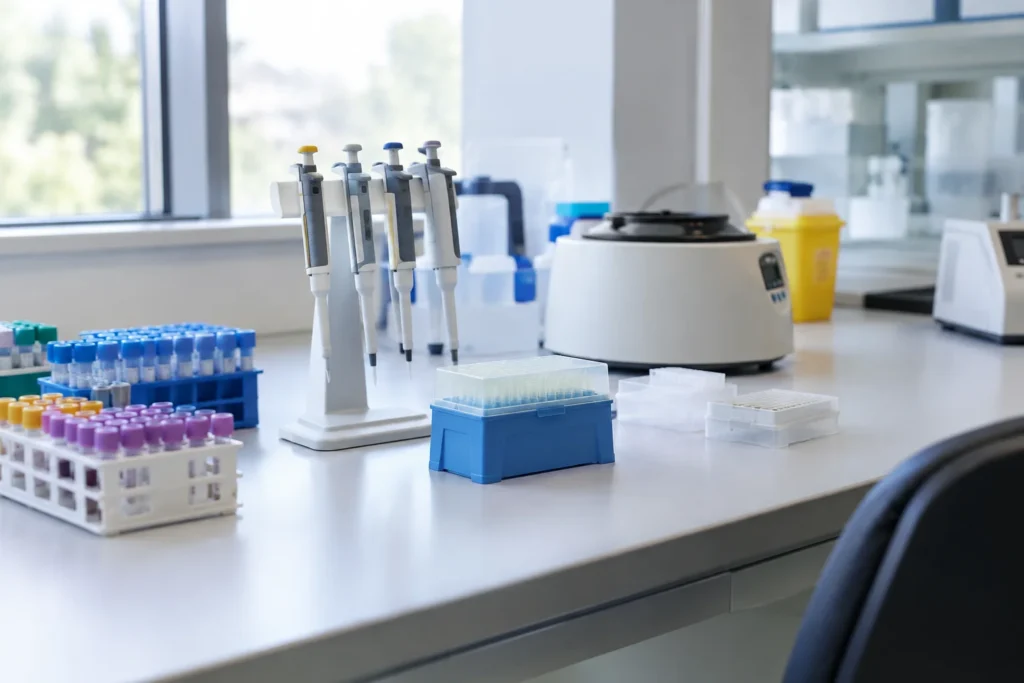
Stepping Hill’s Biochemistry and Haematology teams have received My Green Lab Gold certification. Here is what the recognition means, how assessment works and where the separate joint NHS Green Plan fits.
Gold recognition for Stepping Hill’s laboratory teams
The Stockport blood science laboratory at Stepping Hill Hospital has earned My Green Lab Gold certification for sustainability work involving its Biochemistry and Haematology teams. Stockport NHS Foundation Trust announced the recognition on 15 October 2026. This laboratory sustainability certification concerns everyday working practices within the laboratory, not the environmental performance of the whole hospital.
Gold is the middle of the programme’s five certification levels. The award recognises work described by the trust on energy consumption, waste and resource use, while wider NHS commitments sit within a separate joint Green Plan.
Stockport blood science laboratory: what Gold means
In its announcement of the laboratory’s award, the trust describes sustainability becoming part of daily operations. Its account highlights attention to energy consumption, minimising waste and using resources more efficiently.
The department received a plaque and certificate from the My Green Lab team alongside Siemens Healthineers, which supported the certification process. Colleagues also marked the presentation with a commemorative cake. The announcement date does not establish when the assessment or presentation took place.
Sustainability Manager Laura Swann linked the project to staff taking responsibility within their own teams. Pathology Associate Divisional Director Mark Gordon highlighted the necessary use of single-use plastics and consumables in pathology. Together, those observations explain why staff involvement and resource choices matter within this particular working environment.
My Green Lab lists its levels in ascending order as Bronze, Silver, Gold, Platinum and Green. Recognition reflects the breadth and depth of sustainable practices adopted. My Green Lab Gold therefore represents a defined level within the framework, rather than its highest award.
The blood science services behind the recognition
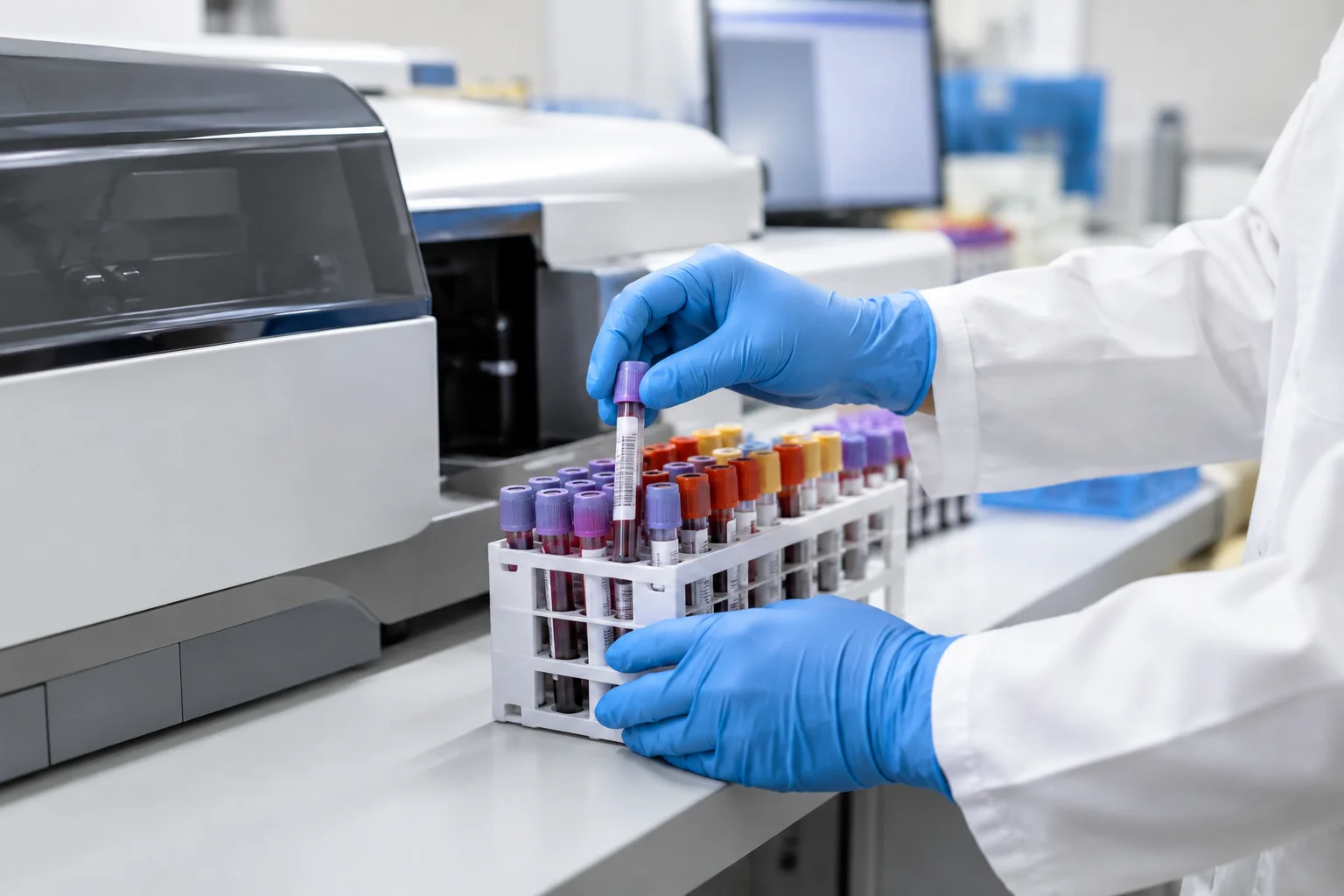
The Biochemistry and Haematology teams work within services that support investigation and monitoring of illness. The trust’s description of its haematology service explains that it deals with disorders affecting blood and bone marrow.
Published examples include anaemia, haemophilia, leukaemia and related blood cancers, sickle cell disease, and other bleeding or clotting problems. This provides clinical context for the laboratory’s work, rather than evidence that the sustainability award changes treatment or diagnostic performance.
Blood transfusion science also forms part of the service. This involves establishing blood group status and providing appropriate blood and blood components. Some staff work in the blood science laboratory alongside colleagues undertaking clinical chemistry and immunological investigations.
The wider clinical haematology service is broader than the teams named in the certification announcement. The trust describes consultants, cancer nurse specialists, chemotherapy and nursing teams working across it. Its published service description identifies the Laurel Suite Day Case Unit and outpatient clinics as principal settings, alongside support for inpatients.
Stockport Pathology’s published operating table lists Haematology and Biochemistry as each operating a 24-hour shift system. Blood Transfusion and Point of Care appear separately with the same shift pattern. Their inclusion in that operating table does not establish that they received My Green Lab Gold.
The sustainability framework’s 14 assessment areas
My Green Lab’s current published framework extends beyond electricity use. It covers 14 categories addressing staff engagement, organisational decisions, equipment, resources and specialist activities. This breadth helps explain why laboratory sustainability certification is not simply a check on a building’s energy consumption.
The programme’s published category illustration names all 14 areas:
- Sustainability culture.
- Infrastructure energy.
- Plug load energy.
- IT and computing.
- Organisational strategy.
- Water.
- Chemicals.
- Synthetic chemistry.
- Purchasing.
- Resource management.
- Travel.
- Waste.
- Field work.
- Animal research.
Sustainability culture and organisational strategy address the people and decisions behind laboratory practice. Infrastructure energy, plug load energy and computing address different aspects of energy use. Plug load refers to the electricity used by equipment connected to power outlets, rather than the building’s wider infrastructure.
Water, chemicals, purchasing, resource management and waste bring attention to what laboratories obtain, use and discard. Travel and the specialist categories show that the programme encompasses different laboratory settings, not just one type of diagnostic department.
The list does not establish that every category applied to Stockport’s assessment. In particular, the presence of field work or animal research in the general framework should not be taken as evidence of those activities within the certified laboratory.
My Green Lab also describes a clinical diagnostic laboratory offering covering patient samples, clinical trials and diagnostic workflows. It addresses automated systems and regulatory requirements. That explains the programme’s relevance to clinical settings, but does not identify the assessment route used for Stockport’s My Green Lab Gold certification.
How assessment and continuous improvement work
The current published certification pathway starts with a baseline assessment. This establishes an initial picture of laboratory practice before teams implement improvements. It includes an engagement survey requiring 50% participation, an assessment tool, review of an impact estimator and submission for baseline review.
The pathway gives an indicative duration of three to four weeks for this stage. That is programme guidance, not a documented timetable for the Stockport blood science laboratory.
During implementation, laboratory personnel work together on changes while continuing to use the assessment tool and impact estimator. The published pathway allows an indicative three to six months for this work. Its emphasis is on collective changes within the laboratory, rather than recognition based only on a statement of intent.
At submission, the laboratory repeats the engagement survey, again with 50% participation, and submits its completed assessment tool and impact estimator. Certification review then verifies selected documentation determined through a risk-based assessment.
My Green Lab identifies Impact Laboratories as its current independent verification partner. Its certification programme information also describes continuing support, progress tracking and recertification every two years. The main programme page says that the baseline stage is not required for recertification.
These details explain how the current system approaches improvement and review. They should not be used to reconstruct Stockport’s assessment history. The trust’s announcement does not publish the laboratory’s numerical score, certification version, assessment responses or expiry date.
Nor does the announcement quantify energy savings or carbon reductions. My Green Lab Gold is the reported recognition; a particular reduction in electricity consumption, emissions or costs cannot be calculated from that level alone. Likewise, the current two-year recertification cycle does not establish an expiry date for Stockport’s award.
The separate joint Green Plan for 2025–2028
The laboratory announcement sits alongside wider organisational planning, but the two should remain distinct. The joint Green Plan for 2025–2028 covers Stockport and Tameside and Glossop trusts. It sets an ambition for carbon neutrality by 2038, rather than reporting that this has already been achieved.
The plan contains ten workstreams: workforce leadership, clinical transformation, digital services, transport, estates, medicines, procurement, food, adaptation and nature. Their scope reaches well beyond the laboratory recognised with My Green Lab Gold.
The document records existing IT reuse and recycling. Its proposed digital actions include greener guidance, expanded virtual wards and rationalisation of printers and hardware. These planned changes are subject to equality impact assessment, which considers how changes may affect different groups of people.
On transport, the plan records four small electric vans at Stockport. Future actions include annual staff surveys, improved walking and cycling facilities, and partnership work encouraging active travel and public transport.
Procurement commitments and progress reporting
The Green Plan also gives suppliers and local businesses a view of the trusts’ procurement priorities. It records a 10% net zero/social value weighting in every tender, alongside carbon reduction requirements in relevant procurements. These are statements in the plan, not a separate verification of current conditions for any particular tender.
Planned procurement actions include sustainability key performance indicators, more Evergreen-compliant suppliers, published supply-chain emissions data, circular procurement and reduced packaging. Circular procurement focuses on keeping products and resources in use, rather than treating disposal as the automatic endpoint.
The plan sets out delivery-group meetings every two months and committee reporting every six months. It also provides for annual board updates and annual action reviews. Those arrangements give the wider programme a reporting structure separate from laboratory sustainability certification.
For Stockport, the completed development is the laboratory’s My Green Lab Gold recognition. The wider procurement, digital and transport commitments remain part of the separately documented Green Plan. Readers seeking the detail can consult the linked plan, particularly its procurement commitments on page 18 and reporting arrangements on page 24.
Sources
- Stockport NHS Blood Science services awarded ‘My Green Lab’ status for improving sustainability – Stockport NHS Foundation Trust
- My Green Lab Certification: The World’s Most Trusted Green Lab Certification.
- Haematology Services – Stockport NHS Foundation Trust
- Stockport Pathology
- mygreenlab.org
- mygreenlab.org
- My Green Lab certification programme and verification information
- www.stockport.nhs.uk